• FEATURED WRITERS:
  • DIVAKAR KAMBLI
  • AMOL REDIJ
  • P. K. DASTOOR
  • ANIKET SAWANT
  • DEVIKARANI KAMATH
  • ARUN DABHOLKAR

FEATURED ARTICLES

Just a few days before the Oscars, I watched “The Artist” Read More ...

One man I have believed who can facilely camouflage pathos Read More ...

He’s an octogenarian! You won’t believe. Read More ...

Lately, Robot has been in news for shrieking Ra. One. Read More ...

What a black humour! To call stylish walker, a langda. Pawan Malhotra as Salim... Read More ...

As not vitiated by a speck of ‘herdship mentality' that Mumbaikars borne... Read More ...

I do not understand whether to cry or enjoy since the day Sachin Tendulkar. Read More ...

Showing posts with label Fiction. Show all posts

One man I have believed who could facilely camouflage pathos with subtle quirky humour was Charlie Chaplin.

I saw and heard Kiran Nagarkar at an event during the recently held Kala Ghoda festival in Mumbai.

And I found second such man.

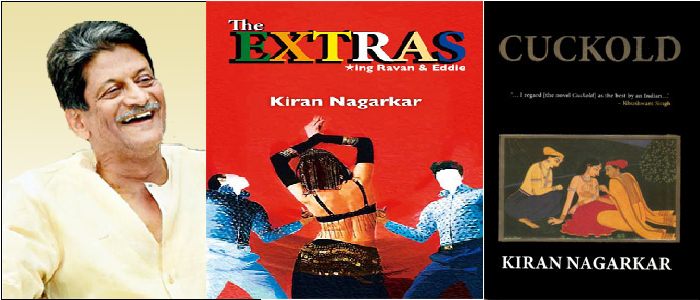
Nagarkar was there for a reading of his latest book, “Extras” a sequel to his most famous and critically acclaimed work, “Ravan & Eddie”.
I got introduced to Kiran Nagarkar through his “Seven Sixes are Forty Three”, English translation of his landmark work, “Saat Sakam Trechalis”. It took almost 20 years for him to publish his second book “Ravan & Eddie” (1994). Both these books are an incredible work of literary fiction that has been injecting me with inspiration.
It is unfortunate that we did not (will not) get to see his 1978 creation, “Bedtime Stories”, which remained banned (extra-legally as Nagarkar claims) for 17 long years and now is almost extinct.
     
His miraculous writing journey continued with 2001 Sahitya Akademi Award winning “Cuckold” (published in 1997) and then in 2006, 9 years later, he published “God’s Little Soldier”. Nagarkar proved his mettle as a prolific writer seamlessly moving from contemporary themes to stories with mythological background. “Cuckold” is a tale about sorcerous Meerabai's husband, Bhoj Raj. “God's Little Soldier” deals with a liberal Muslim boy’s tryst with religious orthodoxy.
My admiration for this man is not a yesterday’s deal. I have read and re-read him through his books and interviews for a decade, almost.
In Nagarkar is an abysmal thinker who has ideas and story-telling skills that are not only abstruse but also thought provoking. He keeps you intrigued and thoughtful throughout the book. He is a laudable caricaturist.
There are not many takers for him (however the little following he has is a serious mass fond of literature). He remains largely unfound.
     
“I sold only 1500 copies in 27 years and I have entered Guinness Book of Records for that,” jokes Nagarkar.
He bristles when Marathi journalists hurl questions at him about he not writing in Marathi; it is natural for a writer who initially and originally began writing in Marathi but could not go beyond a point and switched to English.
It is a sorry state for this state where art & culture were held high once upon a time. Sadly, the Maharashtra government, and more so the literary associations, have wretchedly failed to preserve our literature. I wish Kiran Nagarkar had Kolkata or Koshi as his workplace; he would have been an icon by now. Because unlike other places, these two states strive to keep their art, culture, literature alive; their focus is on “what” and not “who”.
And I also thank God that he did not send William Shakespeare to Maharashtra for he would have perished in 4 years alone, forgetting 400 years of immortal citizenship through literary works (pun not intended).
I have regularly felt and written about the slow decomposition of Maharashtra because of its rapacious leadership. A book makes a remarkable sale of 20000 copies and then 30000 in reprint in Germany. However, our nation (or state) cannot do a little for this splendid writer. We can’t expect a Kiran Nagarkar to go on Facebook, at this age, to blare his success and gather “likes” & “fans”. He doesn’t need to. The focus of our state’s literary associations has to shift from an irritating Bhalchandra Nemade to Kiran Nagarkar. Nagarkar deserves it; Nemade does not.
I am deeply moved by the way Nagarkar is being treated, imagine his state of anxiety.
Read his interview here - http://www.dnaindia.com/lifestyle/interview_literatures-little-soldier-kiran-nagarkar_1637677
Yet he covers his anguish with little giggles, smiles, and banter – the Charlie Chaplin.
- Amol Redij

(Part 2 of 3 part series)

Anagha never pestered Anant. She was different, a guardian like. She spoke to him at length walking through the fields, sitting beside the river, or playing under the jackfruit tree. She talked. He listened. Understanding was not important then. She too was patient to Anant’s blabbering. Anagha hardly got annoyed with him, never actually.
Only once though.
Anagha used to wear a long skirt and a blouse. Her skirts used to be long and beautiful with nice colourful floral designs. Her blouses, mostly bright coloured and shiny, would complement her skirts. Her costumes and dressing used to charm Anant. Anant wore simple short knickers, mostly blue or black or khaki coloured with a white half sleeved kurta, almost every day.
Often when playing and trying to hide away from his Mother, Anant used to skim under Anagha’s skirts and disappear into the darkness beneath. It felt like a long upward tunnel with no opening at the other end. He felt safest there. He used to do this when he got scared. The obscurity under her skirt never scared him though.
Anant was waiting for Anagha to finish her bath. He was sitting on a rock next to a spring, where Anagha usually bathed. Anagha was dressing up behind the bushes. Suddenly, he heard a commotion and a huge crowd of people marching somewhere with fire torches in their hands, they were shouting slogans. Scared Anant ran behind the bushes and hid under Anagha’s skirt, like he always did. To his utter revulsion this time, when he traversed his eyesight up her thighs, he saw a clump of hair there unlike a stalk he had. She had screamed in rage, pulled him out from underneath and hammered him black and blue, almost to death. Villagers took a chance and thrashed him more. They dragged him till his veranda and continued banging him, shouting at him in front of his Mother. With tearful eyes, he could see a blurred picture of his Mother begging to all the villagers to spare her little boy.
‘Please don’t beat him. Don’t be so harsh to him, please. He is just a kid, he is innocent, he does not understand anything,’ Mother continued pleading to the crowd.
Finally she bowed to Anagha for help. Anagha had calmed down by now and she rescued Anant. Mother apologised to Anagha with folded hands. Mother sat resting to a wooden pillar, holding Anant firmly in her arms. They both were crying; Mother was little soft though. Mother’s tears dropped on Anant’s hair, his on her bosom.
Mother complained to her Gods. She began her conversations with them. She cursed them one by one, muttering about why was she the chosen one for all the sufferings.
Anagha and Anant studied together at school. However, Anant could study only till the third standard. A misfortune disabled him from studying further. He could not grow beyond 8 years of age. He matured physically but was impeded mentally. Anagha was blessed with growing intellect, beauty, and stunning physical aesthetics.
Anagha was well aware of his disability. However, that day’s enrage was devastating. Mother explained Anant that he was wrong. He agreed. That was the only rift that took place between Anant and Anagha. Else, their bond was intense, almost inseparable.
Anant loved playing with Anagha. She had everything in abundance – intelligence, prettiness, vigour, smiles, words, and hair. He loved her hair more than her beauty or her eyes or her lips or her fingers. Silky, strong hair; pitch black, yet shiny; the most beautiful feature of the most beautiful girl of the village.
Anant used to run with Anagha in the fields, along the river banks, sometimes up the hill, and seldom on the highways. He was addicted to see her hair flowing freely behind her. It gave him hallucinations.
Anagha took Anant to school on her bicycle. As her cycle pierced the wind, her hair kissed Anant all over his face. The feeling was nothing less than orgasmic. He used to keep smelling her hair. He used to close his eyes and conceive of being in the heaven.
She never liked tying up her hair. Though, she adored herself sitting in front of the mirror, trying various styles. Anant used to stand next to her, assisting her with different ribbons, rubber bands, hair clips. She used to ask him to hold a strand of her hair in particular manner while she experimented. He obeyed accordingly. Anant used to comb her hair and at times run his fingers down her hair when they sat under the jackfruit tree. She used to narrate stories that happened in school. She also tried teaching few things which he could have learned had he been in the school then. Anant used to hold her hair and make a string of hair fall softly on his face. At times, he covered his entire face with her hair. The shade under her hair was soothing.
Anant spent most of his time under the mystiques of his friendship and bonding with Anagha. He was unaware that his Anagha would eventually just become his muse, nothing more.
Anagha was married off to Parshuram. Parshuram owned two trucks and was into business of goods delivery. He was 34 years of age, twice that of Anagha. Her mother had considered Parshuram’s two trucks and reputation that his family had had in the village as the only parameters to give away her daughter.
Parshuram was an ugly, dark skinned, school dropout, with a typical truck driver persona. He had no respect for fellow villagers and was caught molesting women and girls, many times. Under the pretext that driving trucks made him stressful, he consumed heavy doses of alcohol; smoking bidi was a common culture across all village men. However, Anagha’s mother was beyond understanding all this, ‘my daughter is aging, she has ripened enough, she must get married now,’ she pledged by such ideologies. ‘She should get married on time. What’s the use of making her sit at home and play around in the fields?’ she justified herself.
Nobody really cared about what Anagha felt, had any concern for her happiness. Anagha’s wretchedness was evident. Radiance on her face had disappeared into darkness of that of an amavasya night. Her skin was turning pale. Her bones were gaining prominence creating crests all over her face, shoulders, all over her body. She had started looking double her age. Weary, and weak; an old lady of 40 when she was just 24. Anagha had become unhealthy. She had missed the fortune of motherhood twice.
Parshuram was forcing himself on her once. He was drunk. She was about six months pregnant. She hated when he drank and pounced on her like a wild animal. She couldn’t tolerate the stink; neither could fight back his pervert claws. She would fall prey to his licentious wildness, often. To utter embarrassment, at times, Parshuram made Anagha play at the hands of his drunkard friends.
That night, Parshuram swooped on Anagha’s ailing body, she revolted. She tried to throw him away. Anant, like usual, watched everything from the window. He heard a loud slap on Anagha’s face and her scream later. Parshuram was sitting on her, wild like a giant. Anagha’s sari was folded up to her waist. Anant stared astounded at her bright fair thighs, which he had until then only looked up as a burrow full of darkness. Anant stood there shivering holding the window sills gawking at the scene. Parshuram was getting violent. He paid no heed to Anagha’s pleas. In no time his hands had reached breasts and the blouse was ripped open. Anagha struggled to free herself from those merciless claws of a drunkard-sex-maniac. Parshuram bent down on her chest; Anagha tried to throw him away. In the vehement tussle, Parshuram’s mouth had found its way to Anagha’s breasts and his teeth sank into her nipple. Anagha and Anant screamed in unison. She could finally push the animal away. Parshuram fell from the bed. Anagha sat on the bed, gathered her thighs and held them tightly to her chest with hands firmly tied around her legs.
Parshuram got up little while later and in rage pushed away Anagha. She fell on the other side of the bed, trying to adjust her balance; she fell flat on the ground, with a hard punch in her stomach. Her womb turned void. The second time was due to poor health and weakness. She had become frail not to gather enough energy to deliver a baby. No one really cared however. Her mother-in-law thought that it could have been a girl and hence Gods punished her. Having a boy was matter of pride; no one wanted girls. For Parshuram it was never a matter of concern. For him, his only duty towards Anagha was to shove his manhood inside her and order, “Better it be a boy this time”.
Anant witnessed all this through the window sill or through the cracks in the door and windows. He was eye to every torture, ear to every scream. He could only understand that his Anagha was in pain, she cried, and so did he. However, he could never help her. He could never understand how to. Anagha too, started neglecting Anant, as she did not want him to be a part of trouble that she faced.

- Parikshit J.

(Part 1 of 3 part series)


‘Cry! You slut, you bloody witch,’ Manjula, her mother-in-law, shouted at Anagha, ‘it seems that you are sitting for munja, look at the glow on your face.’ There was no way Anagha could have helped her radiantly glowing face, she was indeed so beautiful.
Anagha was sitting in one corner of the cow-dung-plastered veranda. She was wearing a white sari. She sat with her legs forming right angle, her left leg folded, rested on the ground. On her right knee was the left palm, on which was placed the right palm, and her chin relaxed on the top. She looked restless, physically but very composed, mentally. She could not cry despite making desperate attempts. Yes, she was upset. It, however, felt like the woe wasn’t about her husband who lay dead in front of her.
Few men were making preparations with some bamboo sticks, white cloth, gulal, flower garlands, and a steaming pot. He watched everything from behind the huge jackfruit tree; the same tree, under which he and Anagha played, and spent most of their childhood. His mother, Sulekha, had warned him not to go Manjula’s house that day. However, curious Anant could not put his mind to rest.
Elderly women kept crying on top of their voice sitting around the dead body. Men spoke silently to each other. Manjula rushed in and out of her house making arrangements for the funeral. She hurled arrogant looks at Anagha, and cursed her with cruellest of words, ‘Raandechi, there is not a single drop of tear from her eye’, ‘She was waiting for my Chandu to die’, she continued.
Anant felt like running to Anagha. He loved to rest on her back and cling around her neck. But his mother was a fierce woman, dare he disobeyed her. Also, the jackfruit tree was enough to make him feel that he was with Anagha. Anant could not understand anything. He hugged the tree trunk, as hard as he could. His fingers never met.
He kept looking at Anagha’s face from a distance hoping that she would give him a glance, and he could call her to play.
It had been around half a year when he had played with Anagha or even spoken to her. He flew back in times when being with Anagha was so much fun.
Anant played and spent most of time only with Anagha. She used to take a good care of him, during the day time. His mother took care of him after the sunset, the most when she hugged him and slept. Sulekha was a stern woman but loving and caring mother. At times, she used to feed Anant with her own hands, wash and wipe his mouth too. She loved making variety of sweets for her darling. She never spoke about his father, except the he worked at Tahsil office at some faraway place. Villagers, however, gossiped that Sulekha’s husband stays with some Sarode bai across the river. Sulekha tried to dissuade Anant from those talks and asked him not to pay attention to the villagers. Anant always remained in the caring custody of this mother and Anagha, both looked after him lovingly. Anagha more, as Sulekha used to be busy with daily chores and selling pickles, papad, and other homemade eatables to earn livelihood. She sat on the along the highway exhibiting the delicacies to fellow villagers and tourists. The Mumbai-Goa highway was frequented with many tourists.
Anant was born in a beautiful village, very scenic. There were many patches of fields adjoining the highway; boys played cricket on those fields when there was no crop. It took more than twenty minutes to cross those fields. Anant and Anagha ran across the fields holding each other’s hands and then run down a slope that blew clouds of dust behind their stamping feet, straight to the bank of river full of tiny rocks and pebbles. Crossing the river was fun. And then again up the hill for almost thirty minutes to reach home.
Anant’s mother had telescopic eyesight. Her eyes could draw rays of care and motherhood straight from the highway to her home, crossing over the fields, river and trees. That was her tactic of taking care of Anant. She used to exactly point out when and how he had been mischievous with Anagha. Anagha never complained.
Anant played with Anagha only, always. Others spurned Anant. The boys used to hit the cricket ball hard over the fields into the river and ask him to run and get the ball. He used to do a 200 to 300 meter sprint to bring the ball. After three breaths and moments of panting he was made to run again. Village boys and girls used to tie a handkerchief on his eyes and hit hard on his head with their fists or cricket ball. Girls always made him a servant in their game to run errands and fetch things for them. Washing clothes near the village well was another favourite game of theirs. Anant carried buckets of water and tubs of wet clothes for them. Later, he was made to clip the clothes on the drying line. Elders choose to harass him by their pervert acts.
Have you seen a woman or girl removing clothes?’ asked an elderly man whom Anant called kaka. He was taught to say so, to all the elderly men. They were all sitting together smoking chilam while playing a game of cards.
‘No,’ Anant replied, innocently.
A hard slap hit his left cheek, ‘Are you sure? If it is a lie you will get harder than this,’ they all laughed. Anant kept looking at them.
'You have mother at home, right?’ man sitting next to kaka spoke, smoking his chilam hard and blowing a smoke cloud on Anant’s face.
‘Umm,’ he nodded.‘So have you not seen your Mother remove clothes from the cupboard or from the drying line?’ they all burst out in laughter again.He looked at them. He smiled too. Later, he started laughing as well.

- Parikshit J.