


One man I have believed who could facilely camouflage pathos with subtle quirky humour was Charlie Chaplin.
I saw and heard Kiran Nagarkar at an event during the recently held Kala Ghoda festival in Mumbai.
And I found second such man.
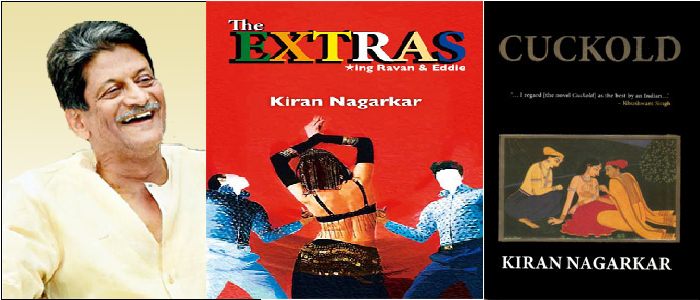
Nagarkar was there for a reading of his latest book, “Extras” a sequel to his most famous and critically acclaimed work, “Ravan & Eddie”.
I saw and heard Kiran Nagarkar at an event during the recently held Kala Ghoda festival in Mumbai.
And I found second such man.
Nagarkar was there for a reading of his latest book, “Extras” a sequel to his most famous and critically acclaimed work, “Ravan & Eddie”.
I got introduced to Kiran Nagarkar through his “Seven Sixes are Forty Three”, English translation of his landmark work, “Saat Sakam Trechalis”. It took almost 20 years for him to publish his second book “Ravan & Eddie” (1994). Both these books are an incredible work of literary fiction that has been injecting me with inspiration.
It is unfortunate that we did not (will not) get to see his 1978 creation, “Bedtime Stories”, which remained banned (extra-legally as Nagarkar claims) for 17 long years and now is almost extinct.


His miraculous writing journey continued with 2001 Sahitya Akademi Award winning “Cuckold” (published in 1997) and then in 2006, 9 years later, he published “God’s Little Soldier”. Nagarkar proved his mettle as a prolific writer seamlessly moving from contemporary themes to stories with mythological background. “Cuckold” is a tale about sorcerous Meerabai's husband, Bhoj Raj. “God's Little Soldier” deals with a liberal Muslim boy’s tryst with religious orthodoxy.
My admiration for this man is not a yesterday’s deal. I have read and re-read him through his books and interviews for a decade, almost.
In Nagarkar is an abysmal thinker who has ideas and story-telling skills that are not only abstruse but also thought provoking. He keeps you intrigued and thoughtful throughout the book. He is a laudable caricaturist.
There are not many takers for him (however the little following he has is a serious mass fond of literature). He remains largely unfound.

 “I sold only 1500 copies in 27 years and I have entered Guinness Book of Records for that,” jokes Nagarkar.
He bristles when Marathi journalists hurl questions at him about he not writing in Marathi; it is natural for a writer who initially and originally began writing in Marathi but could not go beyond a point and switched to English.
It is a sorry state for this state where art & culture were held high once upon a time. Sadly, the Maharashtra government, and more so the literary associations, have wretchedly failed to preserve our literature. I wish Kiran Nagarkar had Kolkata or Koshi as his workplace; he would have been an icon by now. Because unlike other places, these two states strive to keep their art, culture, literature alive; their focus is on “what” and not “who”.
And I also thank God that he did not send William Shakespeare to Maharashtra for he would have perished in 4 years alone, forgetting 400 years of immortal citizenship through literary works (pun not intended).
He bristles when Marathi journalists hurl questions at him about he not writing in Marathi; it is natural for a writer who initially and originally began writing in Marathi but could not go beyond a point and switched to English.
It is a sorry state for this state where art & culture were held high once upon a time. Sadly, the Maharashtra government, and more so the literary associations, have wretchedly failed to preserve our literature. I wish Kiran Nagarkar had Kolkata or Koshi as his workplace; he would have been an icon by now. Because unlike other places, these two states strive to keep their art, culture, literature alive; their focus is on “what” and not “who”.
And I also thank God that he did not send William Shakespeare to Maharashtra for he would have perished in 4 years alone, forgetting 400 years of immortal citizenship through literary works (pun not intended).
I have regularly felt and written about the slow decomposition of Maharashtra because of its rapacious leadership. A book makes a remarkable sale of 20000 copies and then 30000 in reprint in Germany. However, our nation (or state) cannot do a little for this splendid writer. We can’t expect a Kiran Nagarkar to go on Facebook, at this age, to blare his success and gather “likes” & “fans”. He doesn’t need to. The focus of our state’s literary associations has to shift from an irritating Bhalchandra Nemade to Kiran Nagarkar. Nagarkar deserves it; Nemade does not.
I am deeply moved by the way Nagarkar is being treated, imagine his state of anxiety.
Read his interview here - http://www.dnaindia.com/lifestyle/interview_literatures-little-soldier-kiran-nagarkar_1637677
Read his interview here - http://www.dnaindia.com/lifestyle/interview_literatures-little-soldier-kiran-nagarkar_1637677
Yet he covers his anguish with little giggles, smiles, and banter – the Charlie Chaplin.
- Amol Redij


