• FEATURED WRITERS:
  • DIVAKAR KAMBLI
  • AMOL REDIJ
  • P. K. DASTOOR
  • ANIKET SAWANT
  • DEVIKARANI KAMATH
  • ARUN DABHOLKAR

FEATURED ARTICLES

Just a few days before the Oscars, I watched “The Artist” Read More ...

One man I have believed who can facilely camouflage pathos Read More ...

He’s an octogenarian! You won’t believe. Read More ...

Lately, Robot has been in news for shrieking Ra. One. Read More ...

What a black humour! To call stylish walker, a langda. Pawan Malhotra as Salim... Read More ...

As not vitiated by a speck of ‘herdship mentality' that Mumbaikars borne... Read More ...

I do not understand whether to cry or enjoy since the day Sachin Tendulkar. Read More ...

Showing posts with label Writers. Show all posts

Just a few days before the Oscars, I watched “The Artist”, a movie that was much talked about. I was rather a little skeptical to watch it. However, a conversation with Bollywood enthusiast and a columnist urged me to finally book a ticket at a “not-so-good, not-so-bad” theatre in Pune. I wish I could have got to watch “The Artist” in Regal, Eros, Sterling, theatres where I have enjoyed most English classics.
I had had enough of Apes, Spider-men, Lord of Rings, all sorts of aliens attacking our planet, and many other specially-abled creatures with high visual-sound effects.
“The Artist” was a welcome change for my movie watching experience. Black-and-White and Silent, a courageous thing to do in the times of 3D-VFX etc. A wonderfully crafted movie at the able hands of writer-director Michel Hazanavicius, and effortlessly portrayed on screen by Jean Dujardin and Berenice Bejo. The movie is an exciting ride with classical imagery and impressive-inventive filmmaking techniques. It is packed with apt adroitness, euphonious background music, impressive acting with right coalescence of exactitude and melodramatic hyperbole.
In its most entireties, “The Artist” is a work of perfection that B/W hue can be experimented with. I watched the movie once again yesterday. This time, I was transported to the golden era of our black & white movies, when our industry was still known as Indian Cinema and not Bollywood. While I am in no power to draw parallels between “The Artist” and our times of B/W cinema, watching “The Artist” for the second time echoed “Pyaasa” and “Kagaz Ke Phool” all the while; the themes differ though, While Michel's creation has a comical-happy ending base, Guru Dutt movies were dark with tragic ending, but both the creations are equally iconic.
When I talk to some people I know about Guru Dutt movies, ridges of cynicism get etched on their forehead. They consider Dutt’s movies to be slow, melodramatic, and archaic much similar to the reputation that silent movies have. I have seen only few silent movies (including our very own "Raja Harishchandra") and found them to be lissome and amusing contrary to the belief about silent movies. Silent movies focused more on acting skills as evidently referenced in Sunset Boulevard, “We didn’t need dialogues, We have faces”. Filmmaking essentially is a means of communication, expressive means of narration using gestures and body language, when talkies was yet to be defined or rather technique to capture sound was to be devised. Cinema-men’s predicament could have been similar; they had ideas but no means (technically) to convey it. And then facial expressions, body movements, use of eyes was the resort to portray emotions on screen, which appealed to everyone universally, a language could still have been a barrier but emotions are same across the world – an upper curve of lips meant smile and downward meant a frown. Chaplin used this means effectively and to the optimum level, which makes him undisputed king of silent movies.
Guru Dutt has such a widespread that he could have effortlessly made silent movies had he been in those times and he could have masterminded an equally picturesque “The Artist” in today’s times.
This 84th Academy Award winning film shot in black-and-white, is a pleasing experimentation of lights and shadows, of which our own Guru Dutt has been a master. Guru Dutt, a perfectionist with extraordinary vision. Like “The Artist” where language is no barrier to understand, Dutt’s movies too appealed universally and are a subject of research studies till date. I have watched “Pyaasa” over 50 times and each time I have found something new in it. For e.g. when I watched “Pyaasa” recently, I noticed when Dutt stands at the doorway with a halo-like effect behind him, and his hands stretched holding the door frame, it almost resembles like Jesus on the cross; wherein to my understanding, it was like Vijay (the poet in “Pyaasa”) had been crucified by the immoral & selfish attitude of the society, and possibly enlightening the people that what you seek is not the ultimate thing at all through his ‘yeh duniya agar mil bhi jaye toh kya hai’.
Like in “The Artist”, the reel hero (Valentin) and the real hero (director Michel Hazanavicius), concentrate on the form of art than the glamour, Guru Dutt too focused on the artistry and not on the success that is made of few awards or bunch of flowers, may be just like the “Kagaz Ke Phool”. Michel could have easily used the latest technology and effects to make a movie. But perhaps he wasn’t just making a movie, he was trying to make a difference. Much like what Guru Dutt tried to do at that time, when in the post-independence era Satyajit Raj was epitomizing poverty, Raj Kapoor was giving life to street characters of Mumbai, Bimal Roy was marching ahead with social issues, Mehboob Khan was glorifying romance-melodrama. And there was this Guru Dutt trying to differ by portraying a different point-of-view, nihilistic story telling. Dutt focused mostly on the hypocrisy of the society, the pseudo-morals they followed, and the exploitation of the underprivileged.
The poise of “The Artist” lies in the fact that though watching a silent, black-and-white movie, you are in no way conditioned to think that it is an old-fashioned ancient movie. Dutt’s movies had a similar virtuosity that effortlessly bestrode the demarcation between socio-contextual cinema and a form of prevalent movie without burdening the audience.
Dutt was gifted with great musical sense and he was a trained dancer too, which made his movies musically pleasing and aesthetic. He understood the depth of acting which made him a successful director who could make his actors emote naturally. Guru Dutt, a master of camera tactics, along with V. K. Murthy (the best cinematographer Indian Cinema has ever had), captured the best frames, they knew well when to take a long shot and when to capture the glitter in the eye (see Waheeda Rehman in Jaane Kya Tuney Kahi in “Pyaasa”).
“The Artist” a great collaborative effort by Michel Hazanavicius (writer-director), Jean Dujardin and Bérénice Bejo (main leads), Ludovic Bource (music), Guillaume Schiffman (cinematographer), went on to sweep the Academy Awards. Well, a kind of magic that Guru Dutt, V K Murthy, Waheeda Rehman, Abrar Alvi, S D Burman, Sahir Ludhiyanvi created 50 years ago and they could have surely done that today as well with striking screenplay, particularized cinematography, and mellifluous dialogues.
His movies went to become cult classics, with “Pyaasa” and “Kagaz Ke Phool” enjoying the status of finest films ever made with a mention in the prestigious Time. Unfortunately, Guru Dutt could not live so long to see his days of glory, and witness the resonating impact his movies have on hearts & minds of many across the world, they have cult following in Germany, and France, from where comes “The Artist”.
- Redam

One man I have believed who could facilely camouflage pathos with subtle quirky humour was Charlie Chaplin.

I saw and heard Kiran Nagarkar at an event during the recently held Kala Ghoda festival in Mumbai.

And I found second such man.

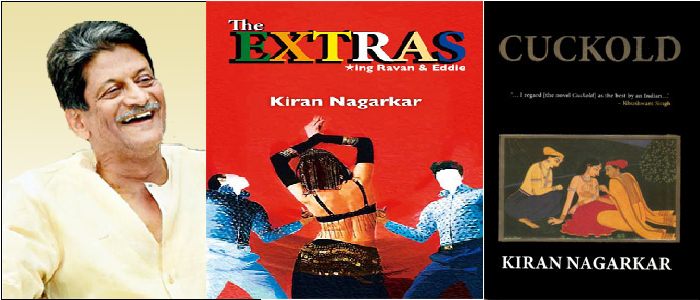
Nagarkar was there for a reading of his latest book, “Extras” a sequel to his most famous and critically acclaimed work, “Ravan & Eddie”.
I got introduced to Kiran Nagarkar through his “Seven Sixes are Forty Three”, English translation of his landmark work, “Saat Sakam Trechalis”. It took almost 20 years for him to publish his second book “Ravan & Eddie” (1994). Both these books are an incredible work of literary fiction that has been injecting me with inspiration.
It is unfortunate that we did not (will not) get to see his 1978 creation, “Bedtime Stories”, which remained banned (extra-legally as Nagarkar claims) for 17 long years and now is almost extinct.
     
His miraculous writing journey continued with 2001 Sahitya Akademi Award winning “Cuckold” (published in 1997) and then in 2006, 9 years later, he published “God’s Little Soldier”. Nagarkar proved his mettle as a prolific writer seamlessly moving from contemporary themes to stories with mythological background. “Cuckold” is a tale about sorcerous Meerabai's husband, Bhoj Raj. “God's Little Soldier” deals with a liberal Muslim boy’s tryst with religious orthodoxy.
My admiration for this man is not a yesterday’s deal. I have read and re-read him through his books and interviews for a decade, almost.
In Nagarkar is an abysmal thinker who has ideas and story-telling skills that are not only abstruse but also thought provoking. He keeps you intrigued and thoughtful throughout the book. He is a laudable caricaturist.
There are not many takers for him (however the little following he has is a serious mass fond of literature). He remains largely unfound.
     
“I sold only 1500 copies in 27 years and I have entered Guinness Book of Records for that,” jokes Nagarkar.
He bristles when Marathi journalists hurl questions at him about he not writing in Marathi; it is natural for a writer who initially and originally began writing in Marathi but could not go beyond a point and switched to English.
It is a sorry state for this state where art & culture were held high once upon a time. Sadly, the Maharashtra government, and more so the literary associations, have wretchedly failed to preserve our literature. I wish Kiran Nagarkar had Kolkata or Koshi as his workplace; he would have been an icon by now. Because unlike other places, these two states strive to keep their art, culture, literature alive; their focus is on “what” and not “who”.
And I also thank God that he did not send William Shakespeare to Maharashtra for he would have perished in 4 years alone, forgetting 400 years of immortal citizenship through literary works (pun not intended).
I have regularly felt and written about the slow decomposition of Maharashtra because of its rapacious leadership. A book makes a remarkable sale of 20000 copies and then 30000 in reprint in Germany. However, our nation (or state) cannot do a little for this splendid writer. We can’t expect a Kiran Nagarkar to go on Facebook, at this age, to blare his success and gather “likes” & “fans”. He doesn’t need to. The focus of our state’s literary associations has to shift from an irritating Bhalchandra Nemade to Kiran Nagarkar. Nagarkar deserves it; Nemade does not.
I am deeply moved by the way Nagarkar is being treated, imagine his state of anxiety.
Read his interview here - http://www.dnaindia.com/lifestyle/interview_literatures-little-soldier-kiran-nagarkar_1637677
Yet he covers his anguish with little giggles, smiles, and banter – the Charlie Chaplin.
- Amol Redij

In cricket, it is said that the hook shot, though most marvelous, is the most dangerous to play. Slight misjudgment and the delivery can hit you like an uppercut, enough to bruise you for rest of your life.

Quite similarly, Ms. Arundhati Roy, our very own, who gave India its first Booker, has been smartly facing the deliveries and surviving at the benevolence of many benefit of doubts.

However, this time, she seems to have missed it. She tried a hook at the Kashmir issue, which unfortunately didn’t go well off the boundary. The timing was wrong perchance. Or maybe the tact; one shouldn’t be playing every delivery between mid-wicket and backward square-leg on the leg side. Some other shot could have possibly made Ms. Roy win praise akin Tendulkar – “pride of the nation”. However, that did not happen so and instead Arundhati had to derogate herself with a taint of “traitor of the nation”.

While her Booker might make us feel proud about the zeal, Ms. Roy’s subsequent acts have only made us feel sour about her ubiquitous performances. For no rhyme or reason, she has been pouncing on every opportunity that she thought could get her publicity and media attention, possible smitten by the honour and reputation that her cousin enjoys.

Arundhati Roy has many times critiqued on the right things. However, more than that, she opined about something that made her image and intellect spiral down. Whether she does it for publicity or to flaunt her astuteness, is something only she can answer or the media can speculate. However, parachuting between issues, like Narmada Andolan, Maoism, Kashmir, and similar, does give a sense of chasing media attention. Given that she has the caliber of winning a Booker, it doesn’t require any super intelligence about how to diplomatically tackle sensitive issues like that of Kashmir and Naxals-Maoists; she can be superbly imaginative about how to conjure up things.

The Guardian, New York Times, TIME, may all praise for the analytical views she has given on Afghanistan, Israel, Sri Lanka, Nuclear Policy but her words in India are certainly taken in a bitter tone, which if continues, can turn out to be a debacle for the pride & prestige that she once enjoyed in India.

It is unarguable that a writer like Arundhati will have myopic and distant imaginative about everything that is happening around and that she is born in a democratic-republic gives her right to expression. However, why do so through petty things that invoke more of blasphemy than eulogy. Ms. Roy has been and is a good writer – a story teller, which one of the most respected literary awards (Man Booker) also has testified. It is then surprising that her quest stalls at winning just one. Her research work too seems to be good, given the fact that she dig up issues that appeal to the masses. However, why not make use of those same research skills to come up with an unthinkable narrative that can fetch her a “Pulitzer”, may be. Or simply be like Hilary Mantel of Wolf Hall (2009 Booker Prize Winner), whose ultimate piquancy is to write, write, and write; keeping all other transient issues at bay.

It would rather be appreciated that Ms. Arundhati Roy gets evolved from and not involved in these issues of national unrest. Taking cues from these issues, glorifying them, building up characters, brewing up a fictional tale, and marching your way to the next the “Booker” or a “Nobel for Literature”, possibly looks more sensible at this time.

Your fans and book lovers surely don’t want to look at you as a “single book surprise”.
- Amol Redij