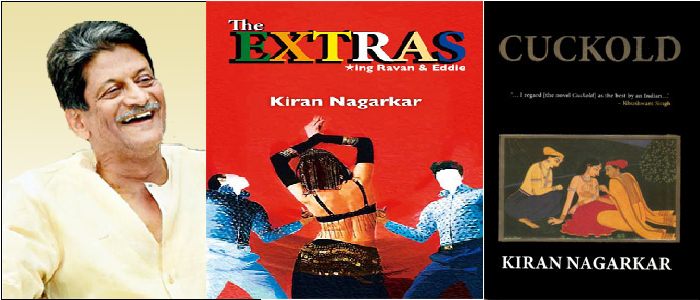
• FEATURED WRITERS:
  • DIVAKAR KAMBLI
  • AMOL REDIJ
  • P. K. DASTOOR
  • ANIKET SAWANT
  • DEVIKARANI KAMATH
  • ARUN DABHOLKAR

FEATURED ARTICLES

Just a few days before the Oscars, I watched “The Artist” Read More ...

One man I have believed who can facilely camouflage pathos Read More ...

He’s an octogenarian! You won’t believe. Read More ...

Lately, Robot has been in news for shrieking Ra. One. Read More ...

What a black humour! To call stylish walker, a langda. Pawan Malhotra as Salim... Read More ...

As not vitiated by a speck of ‘herdship mentality' that Mumbaikars borne... Read More ...

I do not understand whether to cry or enjoy since the day Sachin Tendulkar. Read More ...

Showing posts with label Culture. Show all posts

I entered into the greenery
Adorned in luscious pastures
Like fitly composed landscapes
By God gifted painters

On the way to Kolhapur,
Admiring the Sahyadri ranges
Spiralling the ghat
Driving at sharp edges

At a distance, I stopped
To sprinkle a little water
On my face, and drink some
And have my kanda-bhakari later

Resting under a tree
Near a solid rock stone
I heard a little murmur
I felt someone mourn

Feet tapping tired horse
Next to a glazing sword
I shook a lustrous figure by his shoulder
But he never uttered a word

I have seen him somewhere,
Maybe, in my history book
When the bearded face turned
And gave me a low-down look

I continued to rest then
Little farther from the horse
Moments later, he rose and
Walked to me with remorse

How far you want to reach?
Please tell me, you urban men
Where is my Rashtra, that Swaraj?
Which I had dreamt of then

You have muffed my mountains
That I once proudly guarded
And as a token of marvel architecture
To you, with trust, I had gifted

You have moved into the rivers
You pushed away the ocean
In the lust for an inch more, O Bhavani,
See what they're doing of every town

Panhala makes me panicky
Shivneri makes me shiver
For you'll erase that too someday
To satisfy your bawdy hunger

While trying to build homes
For your warriors, and their wives
Realise, in my forts, if not my mavla
His soul still survives

Look around your state,
The Adarsh that I built
And when I look at yours
I am jittered with guilt

Then he bowed and kneeled
With folded hands, in front me
Like once he did, when young
In front of Maa Bhavani

He will take up the sword again,
I feared, and raze out us all
Like once, while on a rampage,
He had wrecked the Moghul

Filled with guilt I drove away, though
I never had played that game, so dirty
My only fault I realised later
I belonged to Maharashtra's mega city

- RedAm

The rural India is usually looked down upon. People mostly have tanned skin. The infrastructure doesn’t quench our malls-multiplexes-mobiles hankering. The water is examined with suspicion (it is a misnomer though). It is very rare that we, the urban crowd, might shortlist a rural area as a picnic spot, unless that area has good hotels, bars, mineral water outlets, swimming pools, and so on, even though that rural setup is full of exquisite landscapes, refreshing nature, sumptuous greenery, and compassionate people.

However, these areas, which we ignorantly brush under our carpets for they fail to offer us the comforts we desire, are stuffed with copious natural resources and forestation that can satisfy our daily basic needs.

I remember my grandfather narrating a tale to me about a family in our native place that treated the villagers with leaves of various plants and trees. The wisdom had trickled down from generation to generation. This particular family had a peculiar research methodology. And the results never failed. Almost every ailment, disease, illness was perfectly cured with the paste of leaves they offered. There were different leaves to heal different disorders. Curiosity prevailed in the village for this proficiency of theirs until one day it was revealed to a close confidant who happened to be my grandfather.

“It is simple,” said the well researched and proven doctor “our families have been observing the monkeys for long. Most of the times diseases of human beings and apes are similar. Under certain circumstances, monkeys ate the leaves of particular plants or trees. This pattern was studied for long. And thus based on hard gathered observations and sampling analysis, leaves having particular medicinal values were selected for treatment”

Indeed a genius thing that would mock at the medical science research going on in closed hi-tech ultra-modern costly research centres. Imagine the number of cute white rats that could have been spared.

One such worthiness of rural India that I recently came across is the medications that people (tribes) from these bucolic areas practice. No chemicals involved, just pure natural elements derived from plants and food products. It is indeed a wonder that these illiterate people have the innate quality of recognising the exact plant rich in medicinal value. Very apt; quite adept.

One of my friends practicing medicine as an intern in Buldhana district had told me interesting tales about the medicines people used there.

The tribal population, poor and backward socially & economically, had the abundant wealth of knowledge about the medicinal properties of the natural vegetation around and items of daily household use like coconut oil, milk, turmeric powder, jaggery, and so on. The tribes possess the inimitable erudition to heal around thirty one different human related diseases. This knowledge is the prized property of the population here and the elderly respect it to the utmost. The astuteness of medicinal plant species of these people might in future help large research organisations to develop new drugs for the welfare of the mankind. That of course if the flora and fauna are preserved in the right spirits.

Ever since the mankind has evolved, plants have been used for their medicinal values. It is a matter of pride then that these illiterate people have preserved that culture without any selfishness or asking for monetary recognition in return.

Consider for example, root extract of a plant ranbhendi mixed with curd is used to cure piles. Kidney stone can be cured in 10-15 days when treated with decoction of gokharu seeds and zingiber officinale rhizome. Powder of dried aghada plant added with honey can cure asthma in a week. Homogenised mixture of durwa, haral with honey when taken daily for a fortnight helps in maintaining youthfulness. Paste of amba kernels and fruit wall of Emblica officinalis Gaertn when applied to hair prevents baldness and enriches hair growth. Root powder of ashwagandha, askand with cow milk is used to heal nocturnal emission and strengthen the body. Leaves of chincha cooked with anthill soil are used to treat fractures. Intestinal worms can be cured by taking sitaphal seed powder with jaggery before meals for a week.

You will find numerous such examples if you go to explore wonders for tribal land. People from the tribal land have had continuous relationship with the vegetations, and thus have gained profound intelligence about the plants and their medicinal traits and that too at no cost. The tribes and people of the rural India have tremendous faith in their knowledge, their findings, and their timely proven medicines.

Today we are busy eroding the vegetations, devastating villages for our greed of constructing real estate marvels. The loss of biomass, organic productivity, insolvency of soil, mudding of water bodies are making things worrisome. We are busy acculturating and modernizing that will surely deprive us of the traditional information that the primitive indigenous societies have stored and nurtured for generations.
Nutritional supplements and herbal medicines have today become a craze of this generation. It appears and becomes nutritional or beneficial or enriched with medicinal values when it arrives from the foreign land packaged with “Made in USA” marks – is the psychology that we have developed, which unfortunately will only ruin our values, culture, and rich knowledge base.

India lives in villages. There reside the true Indians. You and I of today who munch a McD burger and sip a Coke are pseudos.

Next time when you take the bite of burger and find it as a pleasuring experience, imagine what contentment it will be bit a cashew fruit just plucked from the tree or sip coconut water from the coconut that just fell in front of your feet from the tall tree.

There is after all, a refreshing difference between the natural and the artificial.

- Amol Redij

“Greed, for lack of a better word, is good. Greed is right. Greed works. Greed clarifies, cuts through, and captures, the essence of the evolutionary spirit. Greed, in all of its forms; greed for life, for money, for love, knowledge, has marked the upward surge of mankind and greed, you mark my words…” Gordon Gekko (Michael Douglas) said in the 1987 movie, ‘Wall Street’

Considering only the movie part, I was utterly impressed with that dialog. I grew up enacting that dialog, it had very powerful words. I have seen the movie enough number of times to defeat the claimants of Sholay (insanely boring movie).

However, as stages of maturity and sanity passed in my life, I began to realise that the dialog was good enough only for the delivery part and could not actually be practiced. The upshot of Gekko’s words lessened over a period of time.

It was short-lived though. The words started resonating in my mind when India emerged a country of scams, frauds in 2010 – the CWG, the 2G, and the Adarsh.

There was Bofors in 1986, the fodder scam in 1996, the arms bribery scandal in 2001, and there were people like Harshad Mehta, Ketan Parikh, Telgi, all of which have shamed India repeatedly. Today we have the sucker-games in telecom, lands, food grains, onions, sports and possibly many more to come. The more is dug, the deeper it gets.

Laissez-faire capitalism proponents claim that it is inappropriate to out rightly reject greed as a negative quality. On the contrary greed should be considered as an overwhelming munificent force in human affairs and also an important underpinning for the capitalist system. However, there have been numerous arguments as this portrayal of greed misappropriates it with self-interest, which can be benevolent.

Time and again our country has been plagued with nuisances of various kinds. It was the real rats that spread the epidemic long time ago. The rats have now transformed into politicians, real estate honchos, bureaucrats, defence personnel et al. These blood sucking rats are running in pursuit of power and wealth with negligent thought about the disaster they are causing (and hence probably the word “rat race”).

It takes me by surprise thinking about the psyche of these people who ignorantly want to amass wealth about which they perhaps have no clue when and how they will utilise it. 1.7 lac crore, an amount beyond my imagination; I would perchance spend my entire life counting it (no pun intended).

What is it that so persistently drives the greed of accumulating money power or fame? Is it only the greed and is it pleasure giving in first place? Is peace of mind not important, forget about values or culture or family matter?

I wonder from where does this disproportionate goad to acquire material wealth beyond one’s need arises from. What is worse is this act of greed denies access to legitimate others who are in need of those resources and which can be utilised to build up a society that will give our country a look of a “developed country”. It is the greed of people like these that has left our country at the status of a “developing country”.

It is good to aspire about being rich & famous. It is ubiquitous and conventional in all the civilisations across the world. It would be rather harsh to synonymise this plain aspiration to greed. Greed is usually the far extreme of this aspiration, largely driven by the psyche of collecting huge amounts of money not to spend it but just to have its possession, when considered in terms of wealth. The extreme of consuming drinks for sheer delight is gluttony as is the fanatical greed for sex called lust; underlying psyche in both these examples remains greed.

Greed classically involves acquisition of material possession at the cost of other’s welfare.

Not only politicians or people who have power but I have seen many around me who despite having all the basic needs and freedom of luxury behave insanely yearning for more material wealth. People in their early sixties (who own a house, a car, have wife, pension, other savings, children supporting them, enjoyed vacations, enjoy alcohol, have had enough sex all their life, have enough well wishers around, good friends, etc) still crave for accumulating as much as they can. At that age, possibly, I would have fulfilled all my aspirations.

What is it then that there is something still missing in one’s life? What is this nature of ravenous hunger? Is it because of the society that we live in, which praises and recognises and worships only fame and richness?

Inner selfishness gives birth to greed; a paradox. Greed breeds on unawareness of the self. The greedy always craves for more than what is at hand, even when it is enough to satisfy his/her needs. It is an ineffectual attempt to satiate the barrenness within you. These self defeating and destructive mannerisms arise from unfulfilled puerile needs and the trauma of the adulthood that fails to catch pace with the mates around.

The focus then shifts from yourself and the dissension begins to avoid the self.

I am neither religious nor spiritual. However, I do end up subscribing to Gautam Buddha’s ideology of desire (which the greed is a part of) – the root cause of all human suffering.

- P. K. Dastoor

My friend sent me a text message last week asking me to list my favourite moment, my sad moment, my happiest moment etc of the year 2010. It then dawned on me that countdown for the New Year has begun. I have been waiting for the clock to tick to twelve.

I quickly spiraled down the memory lane to ponder over the year that went by. There were moments that gave me extreme joy. However, there were times when I regret the oysters I threw away from my life when I forgot to see the pearls inside them.

The beginning was scary, life had taken a tumultuous turn and I am still on the recovery path; matters have improved a lot though. The year was a roller coaster ride.

Now, I have began to look at the previous year not only from my perspective and the effects it had had one me but also taking under purview the people who matter to me. For some of my friends their life changed drastically when stork visited them delivering to them the new meaning of life. To a few, life taught painful lessons at the cost of their beloved ones.

Changes were influencing not only personal lives but professional lives as well. The tidal wave of recession made situations worrisome, every step needed a cautious attention, and career roadmap needed a meticulous approach.

Now again the clock is ticking fast. Everyone is preparing for the New Year, to welcome it in their own way. While the younger generation is busy planning to make their evening a happening experience, our parents and grandparents will be seen in front of the TV sets either watching the programs or volleying between channels where lot of astrologers will give away detailed horoscope of the year to come. This happens every year.

However, apart from changing the date in the calendar I wonder what is so new about this New Year. I have no idea how it will be. But just like all you wonderful people, I too will be preparing a list full of hopes, dreams, some resolutions (which will be forgotten come February), new desires, excuses to do more shopping, some expectations, new movies. Apart from all these, I plan to come up with a new list. Something I never did previous year, something I plan to do now every year. I will have that list hung somewhere in my room where I can glance through it every time I pass by it. The list will indeed be very special to me – “The Gratitude List”.

“Gratitude makes sense of our past, brings peace for today, and creates a vision for tomorrow”, words of a elderly wise person.

So, in between those happening parties, lavish dinners, exchanging texts, calls, shopping, celebrations, steal sometime of solitude. A time that is only yours and only for you. Sit back and relax. Express your thankfulness to everyone who made you smile, who made you feel stronger, who inspired you. Reflect upon those moments of adversity and pain when life taught you some lessons without which you wouldn't be what you are today.

Like Eileen Caddy writes, “Gratitude helps you to grow and expand; gratitude brings joy and laughter into your life and into the lives of all those around you.” Gratitude helps you to express from the heart and invite the best in the future. So forget those moments that broke you and let us say our heartfelt gratitude to life and welcome a new beginning, a new you and me.


I am not sure how long my Gratitude List would be but here are few things that I can quickly gather:
  • Thank you for bringing me into this beautiful world.
  • Thank you for giving me the best parents.
  • Thank you for this beautiful place I call My Home.
  • Thank you for those lovely friends.
  • Thank you for this soft, supple and beautiful skin.
  • Thank you for making me reliable, honest and trust worthy.
  • Thank you for bestowing me with creativity. I feel so special and unique.
  • Thank you for all those second looks I got. :)
  • Thank you for bringing those wrong people, without whom I could never appreciate and realise, recognize, admire and preserve those wonderful ones who care for me.
  • Thank you for those adversities and also the strength without which I would never have been this wise.
  • Thank you for all the love.
  • Thank you for making me a Woman.
  • Thank you for the feminity.
  • Thank you for making me, ME.
And thank you to all the wonderful readers of KAHIHI for taking time to read and appreciate our efforts. A huge motivation for us.

With a promise to come out with more on KAHIHI, wishing you all a very HAPPY NEW YEAR 2011!

- Anitha Govardhan

As not vitiated by a speck of ‘herdship mentality' that Mumbaikars borne, I took a robust Bolero and marched towards the western ghat segment in Satara district. No. Not to Mahabaleshwar or Panchgani that have amused Mumbaikars for long or assumed Mumbai suburban look; they are no less crowded than Borivli or Dadar.

We took the other way.

One IT professional, a young lad, took the route which was as inspiring as the weekly program that featured hills and forts by Milind Gunaji, the debonair actor, model and basically a trekker. The route required masculine leg muscles, in the least.
Otherwise eschewed due to its rough terrain, Satara is a vast place and can’t be confined to a small article like this, anytime.

Remember Maratha King Shivaji, with his few hundreds of untrained but courageous supporters, strategically deploying his troops at different forts and locations, impossible to reach by climbing on foot, forget horses, had non-plussed ever boasting Moghul invaders, with the strength of soldiers eual to lakhs.

The main city, more a town, is clean and modest, yet to assume the abnormal shape Pune has acquired and Kolhapur is acquiring.


Sajjangad (Fort of Good People) hardly 10 kilometers away from Satara is situated on mountain range where Sant Ramdas Swami, one of the strategic political advisors of King Shivaji, spent his last few years resting in peace.

You cannot understand how and why can such a Sant or a brave king keep these regions spell bound with their magic and aura, centuries after centuries, unless you visit the place. I always wondered in my school days, why the poor, lackluster, half hungry, those bereft of everything in their life might be visiting such pious and/or historical places. The answer is the spell that gives them cause to survive and fight, perhaps. The spell that would last “Yavatchandra Divakarou” (till the Sun and moon exist). Beseeching may be the facade of the inherent strength unknown to them.

The general habit of differentiating between experimental and commercial form of entertainment is too visible here. Sajjangad is defined and narrated as a spiritual place more than a picnic destination and cast away by many, young and old, which is true.

However, remember what you do in a closed door gymnasium to maintain your health is available here in an open, vast and panoramic backdrop with zero pollution that would definitely enhance your annual take of fitness. Add to that the spiritual intake, a bonus that is not added in your CTC by your employer.

Top up all this with Sant Ramdas Swami’s philosophical poetry by in the form of shlokas narrated in his Manache Shlok and DaasBodh. The narratives are so simple and flowing and touching that, if you are under a long drawn impression that philosophy is something beyond general understanding, your impressions are bound to get shattered.

You’d literally fall in love with the simplicity and the rhythm of the poetry. No parallel work of poetry has been written in last 350 years, I vouch. If you are a book handler and in habit of going through pages, if not an avid reader, the open library on Sajjangad where all the literature of Sant Ramdas Swami is available would drive you to buy Marathi and English versions of Manache Shlok and DaasBodh and read them.

Wai is Centre of Marathi Vishwakosh (Encyclopedia).

Tarkatirth Laxmanshastri Joshi and subsequently MePu Rege took enormous efforts to build the knowledge base in Marathi on the line of Britannica Encyclopedia sitting in Wai city on the bank of Krishna River. It’s the epicenter of knowledge and the volumes on different branches of education, history and science in Marathi are constantly written to bring the knowledge in Marathi.

In consonance with time now CDs are made. The administrative staff here was a surprise being courteous and ever willing to give information like the scholars are imparting the worldly knowledge.

The work is immense and beyond just appreciation. But the most admiring thing about the library I found is that the librarian allowed us to enter and handle the books as it is done in most European and Western countries, thoroughly trusting us though outwardly at least I never looked a studious fellow, I repeat outwardly.

Apart from this the bank of Krishna river is getting into actual lime light as it being regarded as the replica of Ganga Ghat and shooting of sensible and yet popular films like Gangajal, Omkara, Mrityudand etc in recent times due to political interference on the Ganga Ghat.

Earlier, “22nd June 1897”, meaningful Marathi movie (1979) winning two National Awards directed by debutant director duo, Nachiket and Jayu Patwardhan (also the screenwriters, with dialogs from specialist Vijay Tendulkar), based on assignation of British Government officer Rand ICS and Lt. Ayerst by Chapekar brothers annoyed by the behaviour at the time of plague in Pune in 1897, was filmed in Wai showing the foresight of the director-duo.

There are many of this kind of extra ordinary historical, geographical, spiritual and adventurous anecdotes in and around Satara.

A place to be visited after reading about it or the place that will compel you to read about after visiting it.

- Divakar Kambli

Having completed a day long hectic training, I made myself comfortable at the lounge of the hotel where I was accommodated. The lounge was aptly called “Unlock”.

A group of five young (younger than me) men occupied a table next to me. They were engaged in a conversation about movies, beers, girls, and politics, of course. No matter who they are and what we do, politics forms an inevitable part of our daily lives and discussions. You cannot ignore our politicians; you can simply hate them. With so much of dirt sprouting out from the numerous scams in the country the wrath is unavoidable.

Soon their discussion turned serious. Reality started to speak after few mugs of beer bloated their stomach. They expressed their anger, forms of punishment they would want to implement for the scamsters, the change they needed (Obamania perhaps), and that they would need to be a part of the system suddenly came like a revelation to them. Deep into their sub-conscious minds they might have remembered the appeals by the age old and young promotee politicians.

However, what I liked about the group was that they still remained intact to their topic of discussion, and now they were talking sense after they took several trips to the bathroom to empty. They had turned their attention to implement something that little easier than joining politics, possibly less expensive, and yet had a larger reach. “We will make movies, documentaries on political satire,” said one. The group seemed to be a movie enthusiast. So was I. And with their due permission, I joined them.

We discussed at length about the movies based on politics. Not many belonged to satirical genre. Most of them were serious – Hu Tu Tu, Gulaal, Rajneeti, Satta, Bombay, Aandhi, et al. None of them had a comical touchup. Nothing like “Jaane Bhi Do Yaaron” was ever made again. Serious movies often get restored on the superficial level of the memory while films like Jaane Bhi… go deep down into our memory – and that is one way to keep the political wrath kindled in us. Movies like Satta and Rajneeti tend to scare people making it look like an impossible preposition for people to enter politics.

While the whole day training may not have been that fruitful the evening session had lot many lessons to teach.

Back in my room, while browsing through the TV channels flooded with news about scams, I felt the strong urge to do something on political satire based movies. But are the satires seriously taken? A suspicion started piercining my brain. For a moment, I thought I should have been from Kerala or Bengal. Movies away from Bollywood and Tollywood are full of masala & make ups, Movies made in Kerala and Bengal have substance. It is because of the high literacy rate keeping ethnicity in tact, I presume.

Awareness about the social issues exhibited throught their life had made the likes of T. S. Pillai, M.T. Vasudevan Nair, V. M. Basheer and many others all the time great writers and periodical like Malayalam Manorama that has been the highest circulating periodical in regional space.

This literature gave us the director like Adoor Gopalkrishnan. He made serious movies based on serious literature.

His two movies out of eleven, I can quote in this space. Swayamwaram (1972) a debut movie written and directed by him based on middle class angst and transition of middle class of Kerala into a modernist society. It was an attempt to come to terms with the disillusionment in ideologies.

Mathillukal (1988) based on a novel by V.M. Basheer depicting an unsuccessful love story due to parting by a jail wall. When freed from jail Basheer asks, 'who needs freedom? Outside is an even bigger jail.'

And as the young boys were talking about the documentaries let me tell you that AG has made more than twenty documentaries and two short fiction films.

And Bengal has the legacy of Satyajit Ray.

Movies manufactured in Mumbai are more about dreams while those from Kerala factory are about reality. Adoor Gopalkrishnan followed the tradition of Ray to base his movies based on classical literature with social motifs. Of all the movies made in India, Malayalam movies have highlighted politics the most in terms of making issue based movies. Tamil and Hindi movies take politics as a subject only to showcase the hero’s valour of one-man-army fighting the system.

When sinking into the bed with drowsy eyes, I had a sense of hope squirting around my lips in form a smile. There is someone, and a younger generation, which is thinking about fighting the political mess in the country, to take the politicians to task, and bring shame to them. There is a wave of change that slowly erupting under the sea wherein everyone is frustrated with the chaos that politicians and power brokers of this country have created.

Not everyone needs to go the Gandhiji and Bhagat Singh to bring about a change. Few can take up what Tilak tried – gathering people through art and culture.

Hopefully that was what that young lot was trying to do.

- Amol Redij

At times, it surprises me what is so much about getting married. I was waiting in the queue to buy a ticket of Guzarish movie, when I overheard a girl, ahead of me, talking on the phone with her friend, perhaps, about how her parents are so desperate to get her married. “I feel like running away from the house…bloody f&#$,” she said with a disheartened tone while turning back to check if anyone had noticed her saying the “F” word. I saw a frown on her face, full of awe and stress.

That girl was a stranger. Though there is nothing only against girls that I want to comment, most such victims that I come across are girls. I know at least six such girls personally. I know only one such male victim. However, as much as it is unacceptable in our society for a girl to remain a spinster, the same holds true for a bachelor boy cribbing about his marriage or about the parental pressure, and hence boys usually go unnoticed. Thus the entire focus shifts to girls – the same cult which struggles and shouts for a 33% reservation, and for equal rights with men akin “kandhe se kandha mila ke chalna hai with the male bastion” succumbs to parental (and society) pressure often seeking pity under the excuse, “it is simple for you males, it is different for us” or “you guys won’t understand what we have to go through”.

How? Why? I don’t understand.

Primary reason could be our ethos which is obsessed with the norm of settling down, having a family, and living happily ever after (hopefully). Parents assume unnecessary burden of getting their children married and get desperately after it as if they need to heir to pass on their dynastical legacy – a 800 sq. ft. flat at the most with a little left over cash if not everything is spent on the marriage ceremony. What a faux paus!

Does all this really work? I know of a girl who could not bear the agony of being pushed into wedlock, and she finally married someone only to be divorced in less than 12 months. The other similar case that I know is still struggling to settle down with her forcefully chosen husband even after 3 years now.

What ultimately was the use of all those pressure tactics? Just a transformation from one agony to the other.

However, there are four daring ladies that I know who have defied the social norms, objected to their parents’ torture, and taken upon singlehood as their pride. I collectively call them, “The Bold & The Beautifuls”. They are not extremists though. You can call them selfish in a way, and why not, they follow Ayn Rand’s (a female) philosophies, the epitomes of objectivism and virtue of selfishness. “Romantic love, in the full sense of the term, is an emotion possible only to the man (or woman) of unbreached self-esteem” and “I consider marriage a very important institution, but it is important when and if two people have found the person with whom they wish to spend the rest of their lives—a question of which no man or woman can be automatically certain. When one is certain that one’s choice is final, then marriage is, of course, a desirable state. But this does not mean that any relationship based on less than total certainty is improper. I think the question of an affair or a marriage depends on the knowledge and the position of the two persons involved and should be left up to them. Either is moral, provided only that both parties take the relationship seriously and that it is based on values” is what Ayn Rand professes about love and marriage respectively. And the four bold ladies follow that.

These girls hate listening to girls (or boys) who blubber about their marriage tensions. “F*$# off,” they shout simply, “it is for you to decide whether you want to be a lover on whom true love and compassion is bestowed or a slut who is screwed by a same customer every night for that is what he has married you for.”

When argued that at end of the day you need a companion in your old age, someone to share things when you go back home, pat comes the reply, “I don’t need one of that kind in exchange for spreading my legs every night. I would rather need good health and enough money to sustain for rest of my life, and a friend/care taker/companion but not necessarily a husband”

I love when they talk about their singlehood with so much of dignity. They don’t miss giving roses or getting expensive gifts on Valentine’s Day. They don’t sad about there is no one hold their hand or fondle their breasts in the dark corners of the theatre. They don’t miss being kissed or touched.

What is the problem with singlehood? After all, it is all about you being happy.

If you are a single and struggling to find that someone to match up with perfectly or surrendering to your parents’ undue desires then think again. There is nothing wrong in being single. It is just about changing your point of view and attitude. Don’t mourn. Nothing has gone wrong.

In fact there are many things that you can do and enjoy being single. Reconnect with lost friends, go pubbing, read extensively, draw your career roadmaps, set milestones for yourself, plan a vacation, and the list can be endless. Be sure to be disciplined though; don’t be a wild bull. There is nothing as satisfying as enjoying a wholesome delightful life, where everything is yours. Soon you will apprehend the fun of being single, the advantages it has, and singlehood is not a bad thing at all.

It is not something bizarre. Singlehood does not make you look like a loser who has nothing left in life or because there is nobody to love you. On the contrary, it makes you stronger, realistic, and independent. All that it takes is change in approach and strong belief in the self. You have to love yourself and enjoy your own company. If you cannot enthuse yourself it is quite likely “that someone” may not enjoy your company for long. Don’t feel sorry for yourself, in fact mollycoddle yourself, make yourself your priority in life, decide on your pace to lead a content life.

It is not a blight being a single but an opportunity to explore yourself and evolve as a better person. The knowledge of everyday ordinary reality will dawn upon you. A good psychologist friend of mine usually says, “your best friend is just another you.”

Marriages are certainly made in heaven but an infinitesimal error can land you in hell.

Enjoy your freedom. Love thyself.

- P. K. Dastoor

Maharashtra has a ved (mania) for celebration. Of any kind! Come September or August, people of Maharashtra are charged for ten days. They don’t do anything but sing songs in haphazard manner with no mercy to rhythm, they play loud speakers defying 50 decibel limit to express their joy with delirium. Come October and they are ready to repeat the fruitless act. Then Diwali and other single day celebrations follow. Joy one should take, but not to the extent of wasting huge time and expense of keeping one’s career waiting.

Obama came to the city. Far away from the city of Illinois his media managers might have chalked out the itinerary of his India visit. However, imagine Michelle Obama mingling in the crowd of boys of an English medium school in Fort and straight heading to dance to the tunes of an ethnic Koli Marathi song – you’re under loss of state of mind.

It’s never so with Americans at the upper hierarchy and I’m grieved to say, always so, with Indian political counterparts. A fresh like pomphret example of Common Wealth Games in Delhi!

So they planned from a distance that is exactly on the opposite of the globe and executed the plan in filthy Mumbai without a wrinkle on the face. Soon our shameless politicians, with their crest fallen faces, may visit US to study how to reciprocate the gesture in a comparatively clean city. However, let us keep aside the political analysis by the analysts with crooked and favourable angles expressed as a running commentary.

Michelle’s dance! The scene kept cheering the mind. Michelle is a good dancer. She caught to the tunes immediately with Madhuri Dixit’s ease. It’s in their blood. To catch the rhythm. But Barrack was not at ease. Doesn’t matter. In last few, about 20 seconds he tapped on the tunes. That was a symbol of humility. How many of our politicians with their dogmatic face and vain pride could have shown this gesture?

That achieved two purposes. It tickled the hearts of rich and at the same time created a feeling of pride among the original tribes of Mumbai. Bichchare Bhandaris and Pathare Prabhus, other original tribes! Would have the tour planners thought of this? Congress the ruling party of Maharashtra may be able to draw a benefit from this gesture.

Owing to sincere and persistent requests, Obama danced with his sleeves folded and with fastened necktie.

We were taught to button the sleeves while meeting seniors. To fold full shirt sleeves was supposed to be uncouth. The British tight upper leaps are able to gulp the morsel? The Korean and Chinese taken over the garb of dark suits would be able to digest it?

Our Marathi entertainment channels don’t care of President of India and new chief of the state who is a M.S. from California. The dissuading Marathi entertainment channels thumping hideous programmes in the name of humour on the face of the Marathis evading the intro and life portrait of a so educated chief minister. They were accompanied by relatives, the journos in high places, like that in Adarsha Society. Are they not equally sinful in their act?

I had regards about the British stiff upper lip. But in Bush’s time that was burned out by Tony Blair.

It’s said that: a true American never accepts anything for free. He pays for it and pays for best quality. Despite their depleting resources they’ve not given up the habit. Prima facie Obama has made a provision for 50 thousand jobs. BPOs are not affected as the fear loomed a month ago. Go, grab them.

Analysts are not catalysts. Throw them in the recycle bin.

Though so, we have our own iconic example, still intact. Years ago Indira Gandhi danced to the tunes of folk songs of Adivasis in a remote village. She sincerely believed to be a daughter of an Adivasi in her earlier birth. With her grace and a little smile, the impression is as live in my mind as then was.

- Divakar Kambli

I’m not a health conscious person and as such not a calorie or weight conscious. Having been able to maintain constant weight proportional to my height, I don’t have any ailments either. It happens naturally in my case. I don’t make any efforts for that. I have a sweet tooth and eat as much sweet as I feel like, without a trace of fear for diabetes. I don’t do any exercise but to walk in the evenings. I can’t get up before sunrise though I’m no more a nocturnal creature now. I read till late nights instead. There is no restriction of any kind on my eating habits. I can easily gulp couple of vada-paavs or deep fried samosas without any fear. Only thing is that I’m strictly choosy about the friers, the calorie sellers and their selection of oil pulls.

In short, I can be labelled as more of a careless fellow than carefree due to the façade of my behaviour. For all this, I am grateful to my genes. There isn’t a single case of obesity in any of our generations of the past.

Even so I thank the University of California, Davis and the National Center for Food Safety and Technology, Illinois Institute of Technology for their research that people can include potatoes in their diet and still lose weight. This research was presented at the Obesity Society’s 28th Annual Scientific Meeting held during October 8-12, 2010.

The lead researcher Dr. Britt Burton-Freeman, PhD, MS. said, ‘There is no evidence that potatoes, when prepared in a healthful manner, contribute to weight gain. In fact, we are seeing that they can be part of a weight loss program.’ Forget about the research process and the high glycemic index. You’d read it soon when it starts appearing in the newspapers.

Covered on three sides by creek and fourth by sea shore, our childhood was blessed with wholesome diet of fresh fish and red rice that infused in us rich quantities of proteins. It suffices till date, I presume. Mumbai made me vegetarian due to its stinking fish. I feel the stink because I’ve eaten fish lifted straight from a creek or sea unlike the stored frozen sea food eaters of Mumbai. My mother and her brother never ate fish in Mumbai even when it was Bombay and though Bombay duck was famous and not available in our coastal village on the Goa-Maharashtra boundary. I pity the boaster fish eaters, especially in Mumbai. The sea water is polluted everywhere far beyond Mumbai shores and fish get injected with the stink.

It can be deciphered like this – Those who haven’t seen “Lawrence of Arabia” and “The Secret of Santa Vittoria” carefully, will always think Sholay to be a great movie. Or those who have not seen Al Pacino in “Scarface” will always fancy that Amitabh Bachchan as Vijay Dinanath Chauhan in “Agneepath” is great. Such illusions have developed over years and now have taken a form of truth.

Quite similarly, it’s never possible for those who have rejoiced on ice-stored dead stuff to know the real savour of the fresh water fish.

Now what other than a potato can a vegetarian can eat? In any form – boiled, cooked or fried. I am a have been a potato bhakta since ages.

In Irani hotels I’ve eaten dishfuls of potato finger chips with ‘as-much-as-you want’ tomato sauce in college days, with a pani-kum chai after that.

In Kulkarni’s hotel, in Girgaon, I’ve gulped down plates of potato bhaji served without anything; just plain simple bhaji. It’s generally eaten with chapatti or puri. But not so with the Kulkarni’s. He served batata bhaji as a special dish like bhajji plate or batata vada, unwaveringly. Those who ridiculed him before tasting his obstinate dish gulped their words along with the batata bhaji silently. With second dish they started loving Girgaon’s Kulkarni.

The hotel closed down succumbing to the invasion of fusion in eating habits. Purity and defiance necessarily are destroyed. That happened with Kulkarni’s restaurant too.

At home every vegetable and most of the curries had potato. For example, vangi-potato, tomato-potato vegetable and curry, cooked in red chilly masala. The leafy vegetables like methi also preferred getting boiled with potato at home. In Alleppy, I ate more pieces of potato than chicken in a dish way back when I was not a vegetarian.

And who’d forget the most loved and popular Sunday morning Maharashtrian special dish. Batata-poha. I’ve been cherishing it since I was a toddler. Miss a Sunday and I’m uneasy like an addict not getting his intoxicating dose at a certain time. But crown on this all, is my home made batatyachi kaape. It is somewhat similar to potato finger chips, except that kaape are small round slices instead of long chops, and of course tastier being fully wrapped with red chilly masala powder. I can eat one hundred slices fried like this easily at a go without anything else with, I bet, any time.

Cut the washed raw potatoes without peeling and cut them horizontally into two millimeter slices. Apply rawa (grinded rice powder) mixed with red chilly masala powder with a small sprinkle of salt. Fry both sides like a fish on tawa in a suitable dose of oil you like.

Here, we prefer ground nut oil. In south they prefer coconut oil that keeps the hair black till they get the mark of senior citizenship, mostly.

Varan (preferably) or any curry, rice and these slices is a staple diet for both, bachelors as well as spinsters; lunch or dinner perennially, I vouch. Ask the IT girls working in Bangaluru.


To add to all this there is good news from Moses Lake, Washington. The executive director of the Washington Potato Commission says he is halfway through the fourth week of his potato-only diet with five weeks left to go. Chris Voigt said he vowed to eat nothing but potatoes for 60 days to bolster the reputation of the starchy staple, which he said often gets unfairly labeled as unhealthy, the Tri-City Herald in Kennewick, Wash., reported. Voigt said he has eaten his potatoes in all imaginable forms, including boiled, baked, fried, grilled and even a potato ice cream made by his wife. The Moses Lake man's quest has received multiple endorsements, including one from Gov. Christine Gregoire. ‘You'll prove you can eat potatoes without looking like one,’ the governor joked to Voigt. This will gladden even the couch potato eating lots of potatoes!

As for as I am concerned I’ve never looked so and ever looked lanky, I boast here, to the unseen governor there or here.

- Divakar Kambli

Niladri Kumar – a name to beckon, a musician to be devoured! One of the world’s leading sitar players, considered to be an innovator of music, has pioneered latest trend of fusion music.

A performer true to his art, his every performance has been an epoch making remembrance for his audiences. He makes every moment nostalgic – purely by exquisite music, magical fingers that profusely move over the strings to create musical waves as subtle as ripples on a pond, every song crafted as a masterpiece that enriches with greatness with every note he strums – and this majestic fusion of greatness is all due to his stout devotion to the instrument – his sitar. He strikes a conversation with the instrument and the musical contrivance responds politely. He is engrossed and enthralled in the music as much as his audience with every soul at the zenith of musical amalgamation.

Listen to his song “Priority” that he composed and improvised for over 5 years and you will know about his clairvoyance; the song is as beautiful and mystifying as the city it describes – Mumbai! Recently Niladri Kumar performed at the 73rd birthday of the great composer Hridaynath Mangeshkar. Undoubtedly he cast his musical-magical spell there as well. “What a wonderful way to celebrate a birthday,” Mangeshkar must have rejoiced in his thoughts and smiles.

Sivamani, A. R. Rahman, Louis Banks, may have enticed you with their respective skills, Niladri Kumar is no different; he resonates through his instrument. His live performances stir your soul into a rich blend of melody and tranquility that mellifluously promulgates the ‘kalakaar’ inside him.

He reminds us of one another greatest showman, a performer of unmatched parallel, Michael Jackson. He made his audience go swaying at his peppy music, fall at every tap of his feet, left his audience jaw-dropped; Niladri twangs a similar specter. Niladri grips people to his plunking, keeps them gazing at the movements of his fingers reverberating off the sitar strings.

Young and talented, Niladri Kumar is energetic in his performances, fresh in his approach and always wanting to experiment. He is a youth icon to follow and definitely among those young artists who will go on to become a legend! This again reminds us of one such charismatic person, Sachin Tendulkar – a marvel to wonder, who is defining cricket every single day for most of today’s youth! Ask any toddler about his aspirations in life and pat comes a reply, “Be Sachin Tendulkar”. Sachin and Niladri are similar in the manner they define new master strokes with each passing day. Like Sachin creating and redefining cricket, Niladri Kumar too is gradually defining fusion music.

This restless soul with his zest for music, devised an instrument called ‘Zitar’, a unique combination of guitar and sitar. Giving rock effect to the instrument, he is creating ripples in the music world! Performing at Sivamani Mahaleela, he played a segment which can certainly be defined as a ‘metal rock piece’ played on a sitar. Even Sivamani, the legendary percussionist, himself was perplexed for moments with Niladri’s illusion of music. It was better than most of the hand plucking done on guitar by modern metal bands. To compare, Niladri gives these bands a run for their money single handedly.

An obsession with ‘kala’ is a primary factor in making of a legend. Niladri Kumar possesses that. He has music running through his hands, through his fingertips and he speaks volumes through each of his pieces. He has conversation with the audience in his performances, they miss a heartbeat sometimes, at times they just let their heart dance to the rhythm he creates. And that’s how you precisely win people’s heart!

Images Courtesy: www.niladrikumar.com

- Aniket Sawant

Octopus Paul is dead. Probably, world is mourning; Spain certainly; India too. For India is very sentimental about such topics – astrology, predictions, fortune telling; so what if it was an octopus this time and not a roadside jyotishi sitting with a parrot. Indians, by and large, balance well between getting emotional and credulous; hoping sides as per the convenience.

Had Paul not breathed his last on 26th Oct, we could have imported him to predict the Bihar elections and the subsequent KDMC one. At least Paul could have saved us from the pique of “Tu-Tu-Main-Main” sponsored by the Thackeray Bros. The animal could have, to some extent, lessened the cat-and-dog like fight.
  
It would have been a great sigh of relief for them, us, and the media channels to have known whether it was “Uddhav’s Rajkaran” or “Raj Uddhavast” that would ultimately triumph. It then doesn’t matter what the end result it but we love to hallucinate in the galore of predictions and forecast.

Though we tried to sideline Paul claiming it is something we have been practising since ages, with a parrot though, somewhere deep within we all believed in the octopus theory.

Any social gathering or a group in college or residents of an apartment, anywhere once it is revealed that someone can read a palm or forehead, people start flocking to that person rubbing their palm hard on the bum or wiping their forehead with the forearm, to know about their future. Such is the craze.

Once at a wedding, I came across a person who could read palm of the foot. I wasn’t surprised. It is quite possible. Girls, with ghagra pulled up to the knee level, were dying to show him their feet. He was closely looking at the foot of short dark boy and proclaimed, ‘a fortune awaits this boy in next 3 years, and he is going to be a rich man with a business of his own’. The boy was actually a helper of a caterer there at the wedding. It is more than 8 years now, the by hasn’t made any fortune, he still works under the Marwadi caterer businessman. I haven’t seen that foot-palm reader ever since, fortunately for him.

 Our muse with getting predictions for the happenings in our life is abysmal. I usually don’t understand why people are so desperate to kill the thrill of their life.

Cricket channels too had started getting such fortune teller guests to predict the result of the match. The guests did all sorts of things with cards, numbers, stars etc, and gave some statistics. However, in the end, they do mention that the best team will ultimately win. Where is the fortune-teller’s skill then? Even I can make a statement like that.

Bejan Daruwala predicts the movement of the stock market. A reputed entity like CNBC and www.moneycontol.com believe more in what “Ganesha Says...” than what Gujral, Bhansali, Tulsian, etc say. Both the groups are useless anyways.

Channels make money for they know how to tap the emotional turbulence of Indians. We love getting exploited without applying even an iota of rationale to what we hear, see, and do.

Another instance where we love getting manipulated is “Vastu” and “Feng Shui”. Just because some Feng Shui consultant tells us to illuminate our home with bright red things, we buy all sorts of lustrous red that we can get and keep hoping that some great fortune will come kissing us. Feng Shui came from China. The climate there is extremely cold. In the colour wheel, red and yellow are considered to be warm colours, they depict warmth, heat. This is the reason why mostly in Chinese houses you will find abundant use of red and yellow; to possibly neutralise the effect of the cold climate. However, this may not be applicable in India. We already have a warm tropical climate, especially in Mumbai where humidity is so high.

But we are blinded by the sweet words of the astrologers, Feng Shui consultants, numerologists, and so on. By chance, if you make a fortune at all one day, it will be purely because of the hard work and dedication you put in.

Till then you may only dream to accumulate fortune, while your Feng Shui consultant and astrologer is collecting it by the way of hefty fees charged to you.

- P. K. Dastoor

During my recent visit to Lonavala I happened to visit our own version of "Wax Museum". And it is incredible. If you have loved Madame Tussauds, you will simply adore this; in some cases it is much better than the Tussauds.

It is Sunil Kandalloor's third wax museum in India, the earlier ones being at Kanyakumari and Thekkadi.

Sunil Kandalloor, a 38 year old wax artist from Kerala has created statues that could well cheat us for real life personalities. He uses real human hair in his statues. Though there are many statues he had sculpted, most of which are personalities of the South, I am posting A. R. Rahman's statue here, as most of us will recognise him. The other statues are equally and exceptionally good.

No need to fly to London now for a view at the extraordinary art; it is here in India.

- Aniket Sawant

Whenever I’m actually in a houseboat, say in Alleppy or in Malwan (only one houseboat so far owned by one city corporator, Rajan Sarmalkar), I can’t stop myself thinking about David Lean and his Ryan’s Daughter, a 1970 movie, shot on the sea shore of Ireland; why not in Alleppy and its backwaters, the nature’s extravaganza?

Ryan’s Daughter was a big flop in many countries, and consequently in India as well. Or at least it seemed so on the backdrop of unfathomable success of two of his earlier movies - Lawrence of Arabia (1962) and Dr. Zhivago (1965).
(image courtesy: Terryballard, Wikipedia)

David Lean was a strange amalgam of rough nature and a creative mind. The two extremes nurtured inside him quite comfortably.

He used to hate India, however, later married an Indian woman, Leena Velinkar, a high-brow lady moving in political circles of Delhi. He would choose a vast backdrop, like say, Sahara desert as in Lawrence of Arabia, and throw a lanky, fleshless Peter-O-Toole alone to act, or rather parch or burn there. Peter-O-Toole, when the shoot was over, complained to Leena Velinkar saying, “Your husband had decided to kill me in the deserts”. So merciless was Lean.

In Ryan’s Daughter, Lean chose a place called Dingle Peninsula on the Ireland coast. The distant village was one Killary. We too have one in the same name and famous for the earthquakes, but far away from the sea.

The Irish married woman had an affair with a British army officer at the time of First World War. She had to leave the village as the villagers do not approve the affair and the suspicion arisen due to the ammunition stock hidden.

Such a simple plot! But that reminds me of as many waves have reached the Killary village in Ireland.

Sarah Miles, her husband Robert Mitchum, and lover Christopher Jones in the movie wore the Lilliputian appearance, ditto like Peter-O-Toole in Lawrence of Arabia, opposite sea front defying the limits of skyline.

It is Lean’s favourite game. Juxtapose opposites, the ultimate opposites that the super panavision camera available in his times would cover.

Perhaps, Sarah Miles was chosen for the same reason.

Twice, the wife of Robert Bolt (The Man for all Seasons), Lean’s favourite screen playwright, spoke fetid mouthed language. Bolt had Madame Bovary, a novel by Gustav Flaubert, in his mind for screen but after discussion with Lean he loosely adapted it.

Ramesh Sippy directed Hindi movie, Sagar, was loosely adapted from the story of Ryan’s Daughter. As Ryan’s Daughter was a commercial disaster, many did not know the roots of Sagar. The village idiot (Liliput) whom the heroine of Sagar kisses in the end is a cut-and-paste shot from Ryan’s Daughter. Sagar retrieved image of Dimple Kapadia (30) having two daughters to a teenage heroine from where she had given up acting. It won 4 Filmfare awards including that for cinematography. The village idiot missed it and went to the parallel hero.

Hero worshipping!

The team of Ryan’s Daughter and also the director had to face every kind of difficulty.

Alec Guinness, Marlon Brando, Peter-O-Toole, George C. Scott, Anthony Hopkins, Richard Burton, Richard Harris and Paul Scofield were all considered for different roles but had to back out for different reasons. To add to further woes the selected star cast kept on fighting and abusing each other.

Robert Mitchum during the making of the film clashed with Lean and famously said, "Working with David Lean is like constructing the Taj Mahal out of toothpicks."

There were two silver linings about Ryan’s Daughter though. John Mills, for the role of village idiot, won a kiss planted on lips by Sarah Miles and Academy Award for best actor in a supporting role (our Liliput was privileged only with Dimple’s kiss) and Freddie Young for best cinematography, Sarah Miles being nominated for best actress in a leading role and a nomination for sound, inter alia.

MGM spent one million pounds in 70s to reconstruct the forlorn village of Killary to save it from storms. The poor villagers worked as extras. The face of the village changed since then and it has become famous as a tourist spot reviving the economy, and the township around, Dingle Peninsula.

When I feel or read about the earthquakes in Maharashtra, as it happens often, I remember Killari earthquake. Our Killari village in Maharashtra where the worst earthquake that hit India in last seventy years killing ten thousand people in Sept, 1993 which had been well nigh condemned, is waiting for redevelopment for more than one and half decade and for reviving economy after that.

- Campbell D.