• FEATURED WRITERS:
  • DIVAKAR KAMBLI
  • AMOL REDIJ
  • P. K. DASTOOR
  • ANIKET SAWANT
  • DEVIKARANI KAMATH
  • ARUN DABHOLKAR

FEATURED ARTICLES

Just a few days before the Oscars, I watched “The Artist” Read More ...

One man I have believed who can facilely camouflage pathos Read More ...

He’s an octogenarian! You won’t believe. Read More ...

Lately, Robot has been in news for shrieking Ra. One. Read More ...

What a black humour! To call stylish walker, a langda. Pawan Malhotra as Salim... Read More ...

As not vitiated by a speck of ‘herdship mentality' that Mumbaikars borne... Read More ...

I do not understand whether to cry or enjoy since the day Sachin Tendulkar. Read More ...

Showing posts with label Maharashtra. Show all posts

What an irony! His democratic descendants, 400 years later, have downgraded his stature to a sheer statue made of some material that will certainly be nowhere close to the quality of his construction. His robust and well architected forts make it evident even today. The Maratha King constructed and won back many forts impregnable forts and sea forts to strengthen his navy in order to fight the invaders – Moghuls, Dutch and Portuguese. Lamentably, most of the forts are in dilapidated condition. Our current day rulers are not paying any attention to reinforce them but have instead come out with a proposal to construct and install his statue at the cost of 3500 million rupees, that too in crowded Mumbai’s Nariman Point.
The king who cared for his farmers more than anything had strictly ordered his soldiers that not a single complaint of their (farmers) agricultural land being trampled will be tolerated. And look at the sense of his political posterities especially when thousands of farmers are committing suicides and shot dead in his own land.
The caretaker minister of Mumbai, Mr. Jayant Patil was the first man to propose this statue. I think his understanding about Mumbai is gimpy. The memorial must be in South Mumbai, the rulers proposed and the opposition agreed as well without any tussle.
After a long stretch of time, railways have shown astuteness or more so sympathy to Mumbaikars by increasing the local services, which has worked to commuters’ satisfaction. However, the rulers of Maharashtra have undone the good deeds of the railways. Since the men in power want the statue in South Mumbai (Nariman Point), they will indirectly be thrusting additional flow of tourist thus cramming the local train compartments, thereby nullifying the benefits of additional railway services. 
Facilitated are those fortunate representatives of people who would hopefully get inspiration and govern sitting at furlong distance, with likelihood of creating farsightedness!
The story of the statue in a nutshell goes like this:
The memorial was supposed to be built on the lines of the Statue of Liberty in the US and Swami Vivekananda Rock Memorial in Kanyakumari. The proposed 309-foot-tall statue, planned to be located off Marine Drive in the Arabian Sea had faced opposition from the Navy. It was also pointed out that the project will violate the Coastal Regulatory Zone (CRZ) norms. The state government then began searching for another location near the Gateway of India. Patil, who is the current Mumbai City District Guardian Minister also visited Worli Sea Face and Mahim Fort, in order to look for a different location for the statue.
Further, the Chief Minister comments like this: Chhatrapati Shivaji's statue will come up only in the Arabian Sea putting an end to the controversy sparked off by his deputy CM.
On the eve of the budget session, deputy CM had told the media that an alternative site was finalized, as CRZ norms would not allow a statue in the sea. CM told the state legislative council that state government would obtain all the necessary clearances from the Centre within a year and over the next five years it would strive to complete the project.
And why this insistence? For the sake of developing tourism. Shivaji might have laughed through the valleys and mountains spread through the state except in Mumbai.
Tourism Potential and Apathy
Maharashtra doesn’t have any plans or policy on tourism. Sweating locations don’t attract tourists. But robust ones do. And they are ample in Maharashtra more than enough to attract brave and patriotic tourists from any part of the world. However, the politicians here are bent more in creating and maintaining skyscrapers than forts and mountains.
The fact is that tourism was never the forte of Maharashtra and perhaps never would be in future unless the insular set up of the concerned is totally altercated.
So if not Mumbai, what’s the second option?
On the Sindhudurg coast there are many such places where everyone including Shivaji would like to ride on a bronze horse with his ultimate grace as a warrior.
Vijaydurg fort known as the Eastern Gibraltar due to its invulnerability is the best choice.
It’s an inspiring place where Shivaji himself had hoisted the saffron flag of victory after winning the Vijaydurg fort from Adil Shah of Bijapur in 1653.
According to the news float, neither the ruling party nor the opposition wants this to happen. Why? The reasons best known to them.
The reasons are overweening from the point of view of architectural and naval achievement.
We luxuriate on Rommel’s glory as the great desert warrior. However, we have forgotten that Shivaji was the best Admiral ever the world has produced. Rommel’s countrymen have strived to immortalize his magnificence. Sadly, our countrymen are least concerned about such acts.
Why Vijaydurg…..?
Vijaydurg fort is an architectural marvel that was built with strategic foresight by the revered king who hundreds of years ago exhibited a rock-solid example of what and how an infrastructure should be thus slapping a tight smack on the rulers of today who talk of robust infrastructure with their shaky tongue.
Consider this (source- wikipedia):
  1. According to unconfirmed reports, there is a 200m long, undersea/underland tunnel from the fort to the palatial Dhulap house in the village. Supposedly, the roof of the tunnel has been pinched to protect it from landslides and it is also well ventilated. Now the tunnel is partially blocked. If the presence of the tunnel can be confirmed, and the tunnel cleared, it could serve as a tourist attraction of historical and architectural interest.
  2. Recent oceanographic evidence supports the existence of an undersea wall, constructed out at sea at a depth of 8–10 m depth undersea. Made of laterite, the wall is estimated to be 122 mtrs long, 3 mtrs high & 7 mtrs broad. Attacking ships often met a watery grave after colliding against this wall.
  3. 1.5 km from the fort up the Waghotan Creek, exists the remains of a naval dock carved from rock. This is where Maratha warships were built and repaired. The ships built here were of the 400-500 tonnage capacity. This 109*70 mt dock faces the north side and is an achievement of Maratha naval architecture.
No doubt, Shivaji Maharaj is rightly called the Father of Indian Navy.
 
So instead of fighting over petty issues against the Navy and Environment department, our rulers should visit the fort and decide for themselves whether any other place can be more suitable for the unique admiral king. The urban-rich-hypocrite south Mumbai relishing on calcium carbide ripened mangoes and fishery from cold storage can never satiate the socio-cultural charm of Vijaydurg and it’s delicious mangoes on fresh fish straight from the sea.
- Divakar Kambli

One man I have believed who could facilely camouflage pathos with subtle quirky humour was Charlie Chaplin.

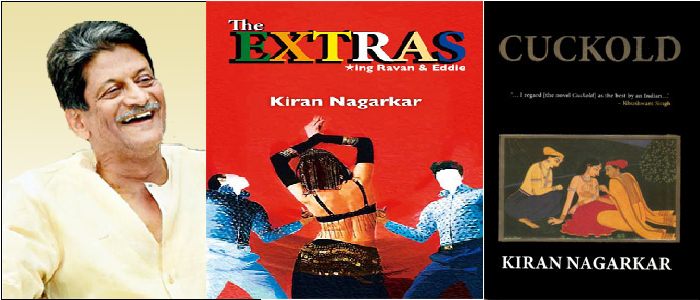
I saw and heard Kiran Nagarkar at an event during the recently held Kala Ghoda festival in Mumbai.

And I found second such man.

Nagarkar was there for a reading of his latest book, “Extras” a sequel to his most famous and critically acclaimed work, “Ravan & Eddie”.
I got introduced to Kiran Nagarkar through his “Seven Sixes are Forty Three”, English translation of his landmark work, “Saat Sakam Trechalis”. It took almost 20 years for him to publish his second book “Ravan & Eddie” (1994). Both these books are an incredible work of literary fiction that has been injecting me with inspiration.
It is unfortunate that we did not (will not) get to see his 1978 creation, “Bedtime Stories”, which remained banned (extra-legally as Nagarkar claims) for 17 long years and now is almost extinct.
     
His miraculous writing journey continued with 2001 Sahitya Akademi Award winning “Cuckold” (published in 1997) and then in 2006, 9 years later, he published “God’s Little Soldier”. Nagarkar proved his mettle as a prolific writer seamlessly moving from contemporary themes to stories with mythological background. “Cuckold” is a tale about sorcerous Meerabai's husband, Bhoj Raj. “God's Little Soldier” deals with a liberal Muslim boy’s tryst with religious orthodoxy.
My admiration for this man is not a yesterday’s deal. I have read and re-read him through his books and interviews for a decade, almost.
In Nagarkar is an abysmal thinker who has ideas and story-telling skills that are not only abstruse but also thought provoking. He keeps you intrigued and thoughtful throughout the book. He is a laudable caricaturist.
There are not many takers for him (however the little following he has is a serious mass fond of literature). He remains largely unfound.
     
“I sold only 1500 copies in 27 years and I have entered Guinness Book of Records for that,” jokes Nagarkar.
He bristles when Marathi journalists hurl questions at him about he not writing in Marathi; it is natural for a writer who initially and originally began writing in Marathi but could not go beyond a point and switched to English.
It is a sorry state for this state where art & culture were held high once upon a time. Sadly, the Maharashtra government, and more so the literary associations, have wretchedly failed to preserve our literature. I wish Kiran Nagarkar had Kolkata or Koshi as his workplace; he would have been an icon by now. Because unlike other places, these two states strive to keep their art, culture, literature alive; their focus is on “what” and not “who”.
And I also thank God that he did not send William Shakespeare to Maharashtra for he would have perished in 4 years alone, forgetting 400 years of immortal citizenship through literary works (pun not intended).
I have regularly felt and written about the slow decomposition of Maharashtra because of its rapacious leadership. A book makes a remarkable sale of 20000 copies and then 30000 in reprint in Germany. However, our nation (or state) cannot do a little for this splendid writer. We can’t expect a Kiran Nagarkar to go on Facebook, at this age, to blare his success and gather “likes” & “fans”. He doesn’t need to. The focus of our state’s literary associations has to shift from an irritating Bhalchandra Nemade to Kiran Nagarkar. Nagarkar deserves it; Nemade does not.
I am deeply moved by the way Nagarkar is being treated, imagine his state of anxiety.
Read his interview here - http://www.dnaindia.com/lifestyle/interview_literatures-little-soldier-kiran-nagarkar_1637677
Yet he covers his anguish with little giggles, smiles, and banter – the Charlie Chaplin.
- Amol Redij

Our books, which are our principal vehicles of expression, can reach people through impersonal mechanisms. This is what makes the world of books so uniquely democratic and accessible.
From the blog amitavghosh.com/blog/ dt. 6th Feb, 2012
*********
I’ll have no hiccups to rank ‘Mukhavata’ in the line of Dostoevsky and Marquez works, minus the sexual overtures. Arun Sadhu is a self-effacing author who believes in the power of fiction to ameliorate society and perhaps the only writer who shuns self-promoting in the realm where internationally recognized authors have surrendered.
Forget the promoting, interviews and reviews.
They accompany you like sycophants. Remember, reading is like wandering through a territory of solitude.
From the blog: DayWalker’s Dreambeats dt. 13th Oct, 2011
*********
These are two views expressed on two different blogs, both devoted to literature leading to the similar conclusion.
Amitav Ghosh (Author: River of Smoke) has expressed in this blog that was repeated in Hindustan Times of Feb7th saying: I suspect that most of us were drawn to the world of books precisely because it provided an island of quiet within the din of *tamashastan*.
In fact, the writer and the writing are omnipresent. But the bad fruits of Information Technology have poisoned the writer to fall unconscious. It’s a case similar to district editions of daily morningers where one gets information restricted to the particular district only.
All literature festivals are mostly successful only because of the attraction the readers feel about the writers and more than that the pleasure of handling the books they never could see in the local book stalls.
Akhil Bharatiya Marathi Sahitya Sammelan is a big annual event in Marathi literary world. This year it was in Chandrapur, coal mine city where the red and black clouds rule the environment along with Naxalite influence.
Everyone, but the hosts, was sceptical about the success of the event this year in Chandrapur. Many of the Marathi book publishers in Mumbai under this impression did mini events of publishing their books neglecting to participate establishing temporary stalls as the practice is.
Astonishingly the Chandrapurians and their neighbouring villages and townships proved everyone wrong. More than a lakh of appreciators of literature visited the conclave buying books worth more than thirty million. Hitherto a record figure. There were no great celebrities in large number. The President Vasant Abaji Dahake, though one of the most brilliant poets and novelists, is not a so called popular figure. However, his thoughts and analysis of why certain literary achievements in Marathi are not yet made on the large-scale universal level were eye opening and quite easy to understand even for the audience which doesn’t take the literature seriously.
The lesson that can be drawn from such an event is simple. People are hungry to read. They want more books on various subjects to see, handle and read. The local bookstall however big or sophisticated it may be doesn’t satisfy their choice. They want to choose the books and where else is a bigger opportunity than such events or medium and large scale exhibitions.
Where is the author in this? May be may not be. It does not make a great difference though his presence is expected and enjoyable.
However, when the author appears as a performer and if he has proved to be controversial, the things may go berserk. In this age of parochial thinking and disrespect, growing incidents happen, as in case of Salman Rushdie at the Jaipur Festival. The events of this kind are on such a rampant growth that someday it may happen to the innocent love story writers; who knows.
It’s the destiny of the writers. They don’t get this kind of glamour. “Instant” and “limelight-full”! It is temporary but the attraction is immense. One can’t resist it.
The actors are destined to this. They get immense fame at a go. The writers have to toil for it lifetime. But the fall also can be speedy. They are fastened together.
Another category is the reporters. They are on the forefront. They visit top notch politicians, dignitaries and rich people and hence know them directly making their life easier and so to say partially glamorous. They are showered with favours and gifts. The media displays them many times making them famous in comparison with the writers. Their editors are bereft of this like the directors of the actors. The writers have their own tiny islands that nobody is aware of.
This difference shall always prevail and the writers who know this shall march ahead winning over the time.
The media cannot make great writers. Maximum it can help shine them like a flash in the pan.
The Ramayan and Mahabharat, the works of writers, lasted over millenniums. Had Walmiki and Maharshi Vyas have to run after the media to promote them?
- Divakar Kambli

It indeed is a good song with foot tapping beats, perfect for a dandiya night. It surely has caught rage with the young crowd. It is simple “hummable” and trendy too. Junior Nigam’s version is even more gripping,
However, there is one more aspect why this song had to get some much fan following or rather could get the needed exposure. Though we want to largely ignore it, the fact remains that song has some association with Rajnikanth.
There are number of other good songs that could have gained prominence had they been exposed or marketed correctly. For e.g. Avadhoot Gupte songs are much better than this recent Kolaveri rage. Gupte’s songs are enjoyable, you can sing them, you can dance on his songs, and you can give a solid performance on his songs, and I don’t only mean “dhingana” here. Avadhoot is not only good with peppy songs but also with soul touching music, though he is largely recognised for the former genre. And mind you Avadhoot is an all rounder, he has made effective movies like Zenda and Morya.
Ajay-Atul, a combo that is lately rocking the Bollywood with Singham and Agneepath. Their compositions are amazing, especially when they strum the rural-cultural chords. “Mayechya halwya”, “Malharvari” from Agga Bai Arrechya, “Lalati bhandar” from Jogwa are terrific compositions. Mind you, “Kombdi palali” or “Chikni Chameli” are just their average level creations. “Chikni Chameli” caught fire only because it has Katrina dancing on that song, perhaps. “Kombali Palali” the original version, a better one, did not catch up so much rage as did Kolaveri.
When it comes to the larger platform, I think Marathi people shy away, get gripped by ‘nyunganda’ (inferiority complex). They are not as outgoing as people from other regions. Shying away could perhaps be a wrong term, it must be the humble nature that we don’t usually show off – the focus is on creativity and not on glamour. More than what “I” think of something, we Marathi people focus on what “others” will think of it, and hence lose out on time and opportunities.
Change! Of course it does not mean get shameless.
A “Kombadi Palali”, “Tujhe Dekh Ke Meri Madhubala”, “Goa mix”, “Lalati Bhandar” are way beyond in excellence of poetics and composition when compared to Kolaveri.
“Ayushyavar Bolu Kahi” another amazing musical that has tight lyrical poetry composed in a melodious musical. I think the audience for such a niche technically perfect melody remains small, and hence “Aggobai Dhaggobai” does not become a Kolaveri, which appeals to anyone and everyone. You don’t need to understand what Kolaveri is trying to convey, it only makes your feet to tap. Sandip and Salil, on the other hand, stir your soul entirely.
It will take time, perhaps, like it took for me. I had been contemplating about this article for over a month, thinking what people will think. But it was getting ironical, what I wanted to write and why I am not writing it.
I am young, and a Marathi manoos that appealed to me most, until recently, was Shreyas Talpade. However, I have noticed, after the Kolaveri effect, that there is a Avadhoot, Ajay-Atul, Sandip-Salil, and there is one Amol Gupte too who can take on Aamir.
And yes I know a few unknowns too – Adwait Patwardhan in Pune of Pancham Digital, Niranjan Jamkhedkar in Mumbai of Studio Tabassum, Amit Redij in Mumbai who does not have professional setup as yet but who is a prodigy in playing variety of musical instruments.
I am happy though that somehow creative people with Marathi background are slowly inching towards fame and recognition. The ‘hare & the tortoise’ story like. Slow and steady will win the race.
- Hanumant Suryawanshi

The last time I had visited the place in Dec 2004, I had absolutely got obsessed with the virgin sea coast, clean beach, and the clear water. The sudden tsunami along the sea coasts did not allow the tourists to enjoy the bliss then. Collecting few cherished memories, cashews, and macchi, I returned back to Mumbai with a promise that I will visit that place again.
“This place has gained prominence because of its long and narrow stretch of beach with pristine waters. On a fairly clear day, one can see the bed unto a depth of 20 ft. It presents a panoramic view with tall 'Shuru' trees in the background. The wide river, the beautiful sailboats and the tiny wonderful islands hamlets situated on the riverbank, add to the picturesque beauty of Tarkarli. Sighting dolphins is not a rare event here.” – sourced from Wikipedia.

Back then in 2004, Tarkarli was an absolute bliss, a beach that wasn’t explored and exploited. The inflight magazine of Air India had advertised Tarkarli beach as Hawaii, such is the wonder of Tarkarli beach situated in our own Maharashtra near Malvan in Sindhudurg district, 570 kms away from Mumbai. Tarkarli beach is fondly also called “Queen Beach”.

7 years later I fulfilled my promise of visiting Tarkarli. I was there in Nov-Dec 2011. Not much had changed except the tourist population, heat, and costs. Back in 2004, Malvani Fish Thali was available at throw away price, not any more. Residents of the area use to rent out a part of their home for the visiting tourists; it had a homely touch then. Now things have commercialized, though not that significantly. The hospitality of the residents, however, remains the same – warm and compassionate.
This time I stayed at the MTDC houseboat for few days and at the MTDC resort later. The beach is the same – clean & clear, the food is tasty as ever, and the people are cool. However, with the influx of tourist, which has risen exponentially over the years, has perhaps resulted in the mismanagement of the place. The people there, the locals, may be are not use to handle such volumes, they have increased their capacities and costs but learning management will require some time, hopefully.

Though my trip was wonderful like the earlier one, a feeling of sadness had slowly crept inside me. The surroundings near the houseboat were in a mess, perchance, because of the habits of the people there and the tourists as well to some extent. The habit of littering around. From a bus ticket to a wafer packet to a 1.5 liter cold drink bottle, we just fly it away once the purpose is served. The tourists (Indians) enjoyed the boat ride but threw away bottles, beer cans, biscuit packets, etc. into the water – really bad. The cook in our houseboat while cutting the fish and vegetable conveniently threw the remains into the water despite having a dustbin in the kitchen.

Output: the surrounding area where the boat was anchored was fully stagnated gathering moss and attracting insects, making the overall experience unhygienic and unpleasant – one reason why I shifted to the MTDC resort abandoning the houseboat.
I wonder how Kerala still manages to keep its backwaters and surroundings clean. May be because of foreign tourists for whom we must keep things clean, matter of first impression and repeats. Also because foreign tourists don’t have ill habits like us of strewing things around.

In all good hope that things will change for good, I still love the Tarkarli bliss and the food there.
Cheers!
-Amol Redij

The master of square-cuts and cover drives is unnecessarily getting caught at silly point(s)!

I do not understand whether to cry or enjoy since the day Sachin Tendulkar (ST) declared that he would be spending 30 hundred thousand rupees on Satya Sai Baba (SSB) statue.
Sachin Tendulkar might be sitting on billions earned by his hard work and genius. However, considering the billions spent on offering completely free cardiac and neurological treatment or on cancer heart ailments that SSB’s trust offered to the aam aadmi, despite the few fragile blocks at the foundation, nowhere brings ST close to SSB.
In this opportunistic world where it has been impossible to have treatment on serious ailments, SSB can be called as a philanthropist of philanthropists. However, the stigma remains irrevocable, wherein his initial cheap hand tricks publicized as miracles thereby assuming the disciples to be idiots, one and all.
ST is a good boy with inexhaustible stamina on the ground and parallel patience in life out of the ground, until recently. But I think he is overburdened of the inertia of the goodness.
Who made him to make a statement that Mumbai belongs to everyone? He was never a politician neither did he exhibit an inclination to be one in the future. Why then should he make such senseless utterance? Or has this apparently patient looking lad come under the spell of an impatient political bigwig? A general doubt!
The examples are aplenty, fresh and stale, that the famous figures in art and sports fields have entered the political field to get mud-slinged and eat dust subsequently; nothing else. Or is there no more place left on the top and the downslide has started?
These two actions of ST have brought him to a level below. It was a matter of a few seconds. Look at the sky, regain patience and keep quiet, exhibiting a masterly “well left” at the question. Absolutely nothing more than what he does on the pitch.
A Don Bradman comparative, who could hide his expressions, cries on internationally televised channels is near to getting comparable with the gaudy heroines of Hindi movies of 70s. Let the tears flow. But to wipe them in such a situation is tantamount to acting. The rudalis and the adivasis who never inhaled the polluted weather of so-called civilized cities crying over the dead body of their near or far people seem more grief stricken though for completely different reasons.
One prima facie obvious shortfall of this public figure is he doesn’t refuse offers. May it be the exemption from customs duty or Bharat Ratna honour. It would cost him nothing much to refuse. In fact it would enhance his image. But no, his close friends think him to be a generous fellow who offers help to a few. They never quote it. They whisper as if involved in a whisper campaign.
Whisper campaigns bear no more value than the gossips, they do not understand. And such examples take away one from the image of model citizenry.
How can a man express a desire to make a statue of the so-called god who has built state-of-the-art hospitals, railway stations, and private airports, with a paltry sum of 30 hundred thousand rupees? Isn’t it ascetically ridiculous? Are there no other prestigious ways like adding this sum to SSBs foundation or helping poor patients with this poor sum?
Or are his advisors overbearing and sullied and decided to belittle him?
Recently I read unbelievable news that he wouldn’t have to pay tax on certain amount of his earnings. In fact he should show the willingness to pay the full amount and set an example of an ideal citizen. From the recent actions of him it doesn’t seem a possibility.
For certain his think tank has started leaking. The advisers are going berserk. They may be legal or accounting experts. But there is always a conscience keeper built in you. It seems to be on the back foot.
ShivSena Supremo, other day warned him on Times Now channel to play on his pitch and not on the political pitch, very aptly. When such interviews (about ShivSena) happen, the chain reaction follows faster than the nuclear process. The media always hungry like Bakasur pounces to get fed by such news.
Loksatta, a Marathi morninger is found playing second fiddle unconditionally (!) to Congress in recent times. The intentions of the erstwhile editor unwritten like British Constitution were known to any Tom, Dick and Harry. He would be the first to fire its flickering salvo against ShivSena. The short sighted writer would search for his thick glasses to reminisce and visualise the handshakes ShivSena made with other party leaders, deliberately forgetting the strange bedfellows of Congress.
The new editor of Loksatta, in his new avatar, is blaming ShivSena for the closure of Marathi schools in the area of its Central office forgetting that the main responsibility being that of ruling state coalition! What a silly statement? May be due to the jaundiced vision.
Had ShivSena been in power, the learned man would have held them doubly responsible and not the opposition then. They need a reason, no reasoning for anything to draw such illogical inferences.
Maid servants’ children are sent to English medium schools. As municipality is ruled by SS, it is their responsibility, the state policy has nothing to participate in the matter; the learned man might be thinking in the manner of Prime Minister. The PM’s perception that economic side is his liability, and the political and administrative liability is hers, might be created due to the haughty thinking, discarding tendency or simply submissiveness. The editorial brain follows the path of the non corrupt, self-effacing man at the helm. Who cares for the corruption that has brought the country on the brink when I am clean, is the silent message that has already reached the billion minds.
Also they insist the children of the leaders of the Marathi cause should attend Marathi medium schools. Why? Shouldn’t they insist for Marathi at par with English and other European languages to attain individual as well as national progress?
What exactly they think is their duty? They are the front runners in the field of improving and raising the standard of Marathi, if not to the international level at least to the national level. What’s their participation? I’ve seen many of them plagiarizing cheap phrases from Hindi movies like “All is well”, a popular phrase from a hit movie by Aamir Khan pronounced in slang, proudly.
Surprisingly psychiatrist like Rajendra Barve too uses the phrase. He may give 112 onionskin reasons for that. But what about vitiating the language? This is no promoting for certain.
The early 20th century thinkers and linguist and editors like Tilak, Agarkar and likes modified Sanskrit and English phrases and words to suit in Marathi (like say, fraction of a second in kshanardha, which is more appropriate than the original) what these Lilliputian editors are contributing? Sycophancy?
In the state where the education ministers didn’t know Marathi, the language of medium of the state, forget objecting to this dire situation, the newspapers sat like ostrich dipping its beak in the burning sand and as a hobby continued printing the interviews of dumb newcomers on the screen and the reviews of who necessarily second or third rate books written by their near ones don’t feel that this situation of language of the medium of education is their prime duty. One can’t expect more than the head-in-the-clouds thoughts from the editors.
I congratulate the new editor for repeating the act of his predecessor, as mostly the editors of Marathi newspapers are just a gloss and not mettle. The newer one too seems to be on his way of proving a flash in the pan. After all we all are traditionalists by lineage and maintain the conservatism till the last drop of our blood is dried or burned.
As he momentarily seems to have fallen in love with the word pitch let me remind that he is playing on the erstwhile pitch of Ramnath Goenka from where many others were pitched out but only Arun Shouri was called back again.
So was it written. But shall so be done?

- DevikaRani Kamath

“A stone in the hands of a rioter is no different than a refined looking black mike in the hands of a TV journalist”. (This is absolutely my quote, and so far no writer or journalist has mentioned it, I presume. As also is the title phrase.)
Both are used for pelting, forgetting law and conventions, deliberately.
Routinely, Nikhil Wagle, the chief editor of CNN IBN-Marathi wing did the same. This man is not ready to forget that the robe he is wearing is that of an editor and not of a reporter. Neither was he a good reporter, as he expressed. The eveninger he owned, lost skin when his chief reporter left him and started one of his own, many readers might remember.
I do not want to churn the past as NW’s favourite daily panelists do.
A couple of days ago, NW relayed a panel discussion on the survival and leadership of ShivSena, thereby breaking all the conventions.
Earlier the panelists used to eschew this subject as the concerned party’s internal matter. Not anymore and the anchors like NW are responsible for this gossip huckstering.
While talking about all morals, they took due care of not hurting the Sena Supremo, Balasaheb Thackeray, and kept on blaming his son executive president of ShivSena and a few next ranking leaders. It was obvious and loud that they are still scared of the roaring tiger’s wrath. Uddhav Thackeray is a cultured man. His command of language and pragmatism is beyond doubt. He, as far as possible, avoids answering using slang and filthy language of those who serialized such campaigns. He sent them packing out of Matoshree, the central office and his father’s residence when he took over as executive president, never to allow them enter ever. The trouble with Uddhav Thackeray is that he is not a mudslinging public orator and leader as one should be in the present times. Now-a-days, one needs to talk on the top of his voice, however illogical or nonsense it may be. One needs to apply Goebbels principles.
Uddhav Thackeray can’t do or doesn’t want to, is his dilemma, though media is ready with red carpet for that.
Now if he, let us assume that for time being, does so, then the same brigade on the TV channels would abuse him for not remaining as cultured as he was a few days before! But the man seems to be making strides as he wants, least worrying about the cock-a-hoop attitude of the discontented political rivals not able to reach to his position. His defectors approve Rahul Gandhi’s elevation to PM’s post; but not Uddhavs Thackeray’s to ShivSena Executive President. It is on recede now. He didn’t whirlpool his neck to the extent of damaging his vocal cords for that.
Now, NW. He did his journalistic career writing against Balasaheb Thackeray and Sharad Pawar as devoutly as any hardcore Satya Saibaba devotee. He and a few others like him could attract some limelight with success.
There is struggle for the gaining top slot among the leaders of ShivSena, and ShivSena as an opposition must survive, were points of NW’s childish discussion on the day.
In the process, the opponents abound, the then scared and now sure of not facing stiff resistance have started vociferating, to satisfy their own bosses.
Bhai Jagtap is slowly making a place for him as a spokesman of ruling party in Maharashtra who was scared away from a northern state as a campaigner. However his disarming tact to appreciate the opponent and then tiptoe into past and into irrelevant anecdotes is getting redundant; he perhaps is not able to make out yet.
One oily faced obscure journo panelist, I’m not sure but someone called him Yuvraj, was given the duty of opposing anything against ShivSena that comes across discussion table a la any Congress spokesmen or pro Congress editors in Delhi. He wasn’t ready to accept anything nor seemed to have understood the subject. He took delight in describing the session stories.
The representative sent by ShivSena was a new one but was not out immediately as expected by others there.
A question was raised over Uddhav Thackeray not allowing any meeting with ShivSainiks unlike Balasaheb Thackeray to whom the new batsman hit a six, pinpointing whether Sonia Gandhi allowed Bhai Jagtap any meeting anytime. The third partial umpire i.e. Nikhil Wagle sitting in anchor room (chair) intervened fast, before Bhai and declared him not out casting away the tantalizing question.
The next panelist was a Communist leader who didn’t budge from his opinion and could have been trouble maker was kept away as the wont of NW is.
Thank Chanakya, NW didn’t invite Sujata Anandan, the scrounging political editor of Hindustan Times whose life time vrat (vow) is to oppose ShivSena and as a whole Marathi political leaders one and all by deriving her knowledge and opinions discussing with her aunt in the kitchen, perhaps.
Next time call her, Mr. NW. it would be a wonderful mess for you.
In short, The Plaster of Paris Panelists were shedding crocodile tears.
I hope to look forward to such a discussion about congress and later on MNS from the quasi gutsy editor.
- DevikaRani Kamath

I entered into the greenery
Adorned in luscious pastures
Like fitly composed landscapes
By God gifted painters

On the way to Kolhapur,
Admiring the Sahyadri ranges
Spiralling the ghat
Driving at sharp edges

At a distance, I stopped
To sprinkle a little water
On my face, and drink some
And have my kanda-bhakari later

Resting under a tree
Near a solid rock stone
I heard a little murmur
I felt someone mourn

Feet tapping tired horse
Next to a glazing sword
I shook a lustrous figure by his shoulder
But he never uttered a word

I have seen him somewhere,
Maybe, in my history book
When the bearded face turned
And gave me a low-down look

I continued to rest then
Little farther from the horse
Moments later, he rose and
Walked to me with remorse

How far you want to reach?
Please tell me, you urban men
Where is my Rashtra, that Swaraj?
Which I had dreamt of then

You have muffed my mountains
That I once proudly guarded
And as a token of marvel architecture
To you, with trust, I had gifted

You have moved into the rivers
You pushed away the ocean
In the lust for an inch more, O Bhavani,
See what they're doing of every town

Panhala makes me panicky
Shivneri makes me shiver
For you'll erase that too someday
To satisfy your bawdy hunger

While trying to build homes
For your warriors, and their wives
Realise, in my forts, if not my mavla
His soul still survives

Look around your state,
The Adarsh that I built
And when I look at yours
I am jittered with guilt

Then he bowed and kneeled
With folded hands, in front me
Like once he did, when young
In front of Maa Bhavani

He will take up the sword again,
I feared, and raze out us all
Like once, while on a rampage,
He had wrecked the Moghul

Filled with guilt I drove away, though
I never had played that game, so dirty
My only fault I realised later
I belonged to Maharashtra's mega city

- RedAm

Rahul Gandhi should visit Hollywood instead of draught prone hinterlands of Maharashtra that he is fond of. Not because he looks like a western actor with an expressionless face and faltering dialogue delivery like Clint Eastwood, not an A class actor, but because he thinks at least to extent in Hollywoodian manner. Clint Eastwood also is movie maker.

RG said that the social schemes devised by Maharashtra were followed by the country for the welfare of the people. The phrase, aam aadmi is out of fashion?

The schemes like Co-op Movement, Panchayti Raj, Employment Guarantee Schemes, he meant. Absolutely true, though the English press has always tried to suppress such positive news in their reports as far as Maharashtra is concerned.

There is saying in Marathi – the sun doesn’t stop rising though the cock doesn’t bang. Now Rahul Gandhi’s sun has risen though may be later in the morning and at odd times.

As a son he is also pushed on the eastward horizon to rise!

Now why do I feel RG should go to Hollywood?

The Hollywood public has a habit of lifting the original stories from across the other part of the world, polish them, buff them, gloss them at an exorbitant cost and present the chakachak copy with a big bang in the world market.

One example is enough; “Seven Samurai” (Originally Japanese) of Akira Kurosawa to “The Magnificent Seven” in English. I doubt whether one fourth of the world viewers are aware of Kurosawa and how important and influential director he is.

Ditto welfare schemes devised by Maharashtra. One percent of the Indians may not know about it.

RG, lovingly (!) called Prince by some section of media also has a script in mind for his movie. The movie this time is based on eradication of corruption and may be in two parts.

Now the production scenario:

In the first part the storyline will move around the action to be taken, immediately against corruption cases. This will go on the sets soon. Lots of young actors can be considered for the leading role from his brigade. But preference will be given to those who are not from a pedigree of politicians, the dynastic leader said.

There were whispers of laughter from the attendees of the press conference.
   
The first assistant director would be Ashokrao Chavan. But the gossip columnists say there is a big tussle behind the screen for the post. Vilasrao Deshmukh wants to push Ashokrao Chavan to the second place that may be agreed to as the planning chief of the studio is in latter’s favour.

Though a Hollywood production, the crew and cast is totally Indian. Top to toe (touching his head to the foot fingers of a baba) believer in Indian superstition, the frustrate has decided to reinstate himself back as Ashok Chavan under the auspices of Satya Saibaba after his secret visits.

In the earlier Marathi-Hindi bilingual production under the same banner Baba had advised to change the name. The movie bombed and hero Ashok Chavan who also did a miniscule role of a police waiting for the Prince (why? Nobody knows) under a tree was dismissed in the next production. Vilasrao (rao, in tact) was the production manager then. Gladly!

In all other productions earlier, he was the most favourite hero. However, in his efforts to push his son under another banner making a movie on terrorism on a five star backdrop was not appreciated by the production house, dismissing him from the scenario sending to a distant studio.

It is rumoured that he is being brought back. The signals are shining visibly green.

Having decided to take an ambitious plunge in Hollywood, the shaky director, though backed well on all other aspects of cinema making, is uncertain about choosing the villain.

Suddenly there is such a crop of villains like Congress grass that it has been difficult to choose the main villain. A. Raja and Thomas are the leading names. However, as per public survey by competing studios, names of our earlier two heroes are also in the race, though they are reluctant.

They have already offered them the roles of villains.

The henchmen and ruffians around the villain had no count. They are available in million, ready to do any role, like willingly throwing the administrative officers in fire. They are fed up of wielding Pt.32 revolver like Clint Eastwood in sixties, boring now.

The music director is not finalized yet. But from the script that is almost ready it seems that Nero from Rome would be the one called from the past with mainly using fiddle. Who can befit more than him when the land is burning under the black market of adulterated fuel?

There may not be any heroin in the movie. But Sushma Swaraj has a big role to play. RG, the director is not in favour to cast her. The movie pundits have however warned him to introduce her, lest the movie won’t see the midnight of the release.

The director on the visit was heard murmuring to himself aloud not to pay any attention to her. But he knows it’s meaningless.

The publicity team however is far below par. The secretaries, with nothing to tell when asked in the press conferences whether the movie is based on the real truth, bark one and all on the question callers and go back to 1998-2004 regime of the opposition party not allowing anyone to hear anything, including themselves.

India feels this stray category of publicity has already sunk the movie before going on the floor. Both the studio heads, planning and executive, are having stiff upper lips though none of them is British to do so, mostly out of fear of losing the chairs thinking of the aftermath of this venture handed over to the novice.

The sets are ready. Many court sets are under construction. Some with slanting roofs of clay tiles, resembling European court buildings. Outdoor shooting would be mostly done in Maharashtra as the thriller has the backdrop there. The foreign locations are Zurich and doubly landlocked (means where a person has to cross at least two borders to reach a coastline) alpine country Liechtenstein situated on the border of Switzerland.

Nobody knows when the movie would be completed and released or whether it would be finished at all.

In the meanwhile, Prince, the director has declared with misplaced expressions on his face, one line story of the sequel, saying - in the long run there was a need to cleanse the political system.

It would take more time than Pakeeza (14 years) by Kamal Amrohi or The Thief and The Cobbler (31) years a Canadian animation film conceived by Richard Williams based Arabian Nights, any young boy not allowed to question in his pompous Q & A programs in cities would tell.

- DevikaRani Kamath

‘Maharashtra is a mahajoke,’ a young boy from a southern state of India told me. He was in Mumbai for two years and knew about the state much more than the youth of his age from the land – politically, culturally, and financially.

‘Why?’ I asked him with a bit of disdain, though somewhere within I concurred with him.

‘See, you all here are joking. Right from a budding actor to your chief minister, people have no other business it seems!’

I couldn’t refute his statement because it was true beyond doubt.

One of the earlier two chief ministers, handsome looking than his actor son always told the anecdotes about the jokes in his career time on stage, in his interviews or on Marathi news channels. His smile is good, might have been liked by the ruling squad of the country. And hence he could have been reinstated as the chief minister. The reasons may be abundant. The Pandora box is opening and other reasons for his baxishi (the chief minister could not pronounce ‘s’ properly, he said ‘sh’ for ‘s’) may pop up soon. Then it could turn out to be a tragical humour!

“Umar-e Daraj Mangke Laye Theyy Char Din…” half of them he wasted on telling jokes and rest in obeying orders of Delhi.

Maharashtra is fond of homour. ChiVi Joshi, Acharya Atre, PuLa Deshpande and though a mainly politician, Balasaheb Thackeray, through his circuitous speeches have kept the tradition. That was a kind of - old as gold. However, over the generations the pedigree is spifflicating the legacy.

Aso.

Anyhow a minor reason caused to stop this joke and Maharashtra heaved a sigh of relief from invasion of jokes in political life.

Delhi sent an MBA to Maharashtra to rule as a CEO.

One more smart sigh of relief. An MBA would rule the state. What a fortune! Smart fellow. Smart talker with a bit extra smart tone. But this talker had a relationship with tower. Who knew? The smartness was a rudeness, who knew?

The MBA proved not to be a CEO, but yours obediently.

The bobda (dull in talks) prince is his master.

I’m coming to Mumbai to challenge ShivSena, prince messaged. Obedient CEO massaged himself for duty, collected all the police force from other duties and employed them to protect the prince as if there was going to be a borderline battle. The prince traveled with full protection in a local train specially emptied for him.

The MBA, CEO, Chief Minister of the once upon a time the most progressive, reformist state, himself left the place of his work brushing aside his formal duties and marched to the destination that prince was to visit.

Message flashed – I’m reaching within half an hour.

But he is a prince after all. He has his whims. Is it compulsory for him by law or convention to reach the destination within the stipulated time?

Would he care that chief minister of a big state, the biggest financial earner to run his kingdom, is waiting for him? Never mind. He took a diversion en route and reached his destination after couple of hours. Diversions are not new to Maharashtra!

Our CEO, visibly embarrassed, sat underneath a mango tree holding his right cheek fallen like a lorn in right hand as a policeman on a duty or a door keeper at his own cabin does.
(Memory pricked me to remember Sean Connery and Ursula Andress in the first James Bond movie, Dr. No that had a song – “underneath a mango tree”)

Has Maharashtra ever been conflicted by a more cruel joke than this?
And that even though he continued raising the towers of corruption is daily coming out before Maharashtra, India, Asia, the world, the earth, the universe and so on….

Hehi aso.

A new chief minister, wisdom prevail, that Delhi has sent.
M.S. from University of California.
He is a Member Consultative Committee, Ministry of Science and Technology, Electronics, Atomic Energy, Standing Committee on Science and Technology, Finance and Planning, Rural and Urban Development, Committee on Public Undertakings, Public Accounts Committee, Standing Committee on Energy and many others.

With such a vast range of experience of work and guts to defy the viciously powerful builder lobby in Maharashtra while assuming the already badnaam post he may wash out the buffoon’s image his predecessors have created, one feels.
Anna Hazare, the only Gandhian left in the country, also feels so.

Notwithstanding, Raj Thackeray doesn’t. The new CM’s action may soon make him change his opinion.

For me, I remember the CM in a beautiful movie packed with positive outlook, SARANSH. The chief minister at the end of the movie says to his teacher – ‘There is still a hope.’

Who would forget that chief minister enacted by Akash Khurana, the epitome of simplicity, authority, and sophistication one feels a politician should be like.

And, I hope to write soon to that young friend of mine from southern state that, Maharashtra is ‘mahawoke’ from that nightmare of joke.

- Divakar Kambli

The rural India is usually looked down upon. People mostly have tanned skin. The infrastructure doesn’t quench our malls-multiplexes-mobiles hankering. The water is examined with suspicion (it is a misnomer though). It is very rare that we, the urban crowd, might shortlist a rural area as a picnic spot, unless that area has good hotels, bars, mineral water outlets, swimming pools, and so on, even though that rural setup is full of exquisite landscapes, refreshing nature, sumptuous greenery, and compassionate people.

However, these areas, which we ignorantly brush under our carpets for they fail to offer us the comforts we desire, are stuffed with copious natural resources and forestation that can satisfy our daily basic needs.

I remember my grandfather narrating a tale to me about a family in our native place that treated the villagers with leaves of various plants and trees. The wisdom had trickled down from generation to generation. This particular family had a peculiar research methodology. And the results never failed. Almost every ailment, disease, illness was perfectly cured with the paste of leaves they offered. There were different leaves to heal different disorders. Curiosity prevailed in the village for this proficiency of theirs until one day it was revealed to a close confidant who happened to be my grandfather.

“It is simple,” said the well researched and proven doctor “our families have been observing the monkeys for long. Most of the times diseases of human beings and apes are similar. Under certain circumstances, monkeys ate the leaves of particular plants or trees. This pattern was studied for long. And thus based on hard gathered observations and sampling analysis, leaves having particular medicinal values were selected for treatment”

Indeed a genius thing that would mock at the medical science research going on in closed hi-tech ultra-modern costly research centres. Imagine the number of cute white rats that could have been spared.

One such worthiness of rural India that I recently came across is the medications that people (tribes) from these bucolic areas practice. No chemicals involved, just pure natural elements derived from plants and food products. It is indeed a wonder that these illiterate people have the innate quality of recognising the exact plant rich in medicinal value. Very apt; quite adept.

One of my friends practicing medicine as an intern in Buldhana district had told me interesting tales about the medicines people used there.

The tribal population, poor and backward socially & economically, had the abundant wealth of knowledge about the medicinal properties of the natural vegetation around and items of daily household use like coconut oil, milk, turmeric powder, jaggery, and so on. The tribes possess the inimitable erudition to heal around thirty one different human related diseases. This knowledge is the prized property of the population here and the elderly respect it to the utmost. The astuteness of medicinal plant species of these people might in future help large research organisations to develop new drugs for the welfare of the mankind. That of course if the flora and fauna are preserved in the right spirits.

Ever since the mankind has evolved, plants have been used for their medicinal values. It is a matter of pride then that these illiterate people have preserved that culture without any selfishness or asking for monetary recognition in return.

Consider for example, root extract of a plant ranbhendi mixed with curd is used to cure piles. Kidney stone can be cured in 10-15 days when treated with decoction of gokharu seeds and zingiber officinale rhizome. Powder of dried aghada plant added with honey can cure asthma in a week. Homogenised mixture of durwa, haral with honey when taken daily for a fortnight helps in maintaining youthfulness. Paste of amba kernels and fruit wall of Emblica officinalis Gaertn when applied to hair prevents baldness and enriches hair growth. Root powder of ashwagandha, askand with cow milk is used to heal nocturnal emission and strengthen the body. Leaves of chincha cooked with anthill soil are used to treat fractures. Intestinal worms can be cured by taking sitaphal seed powder with jaggery before meals for a week.

You will find numerous such examples if you go to explore wonders for tribal land. People from the tribal land have had continuous relationship with the vegetations, and thus have gained profound intelligence about the plants and their medicinal traits and that too at no cost. The tribes and people of the rural India have tremendous faith in their knowledge, their findings, and their timely proven medicines.

Today we are busy eroding the vegetations, devastating villages for our greed of constructing real estate marvels. The loss of biomass, organic productivity, insolvency of soil, mudding of water bodies are making things worrisome. We are busy acculturating and modernizing that will surely deprive us of the traditional information that the primitive indigenous societies have stored and nurtured for generations.
Nutritional supplements and herbal medicines have today become a craze of this generation. It appears and becomes nutritional or beneficial or enriched with medicinal values when it arrives from the foreign land packaged with “Made in USA” marks – is the psychology that we have developed, which unfortunately will only ruin our values, culture, and rich knowledge base.

India lives in villages. There reside the true Indians. You and I of today who munch a McD burger and sip a Coke are pseudos.

Next time when you take the bite of burger and find it as a pleasuring experience, imagine what contentment it will be bit a cashew fruit just plucked from the tree or sip coconut water from the coconut that just fell in front of your feet from the tall tree.

There is after all, a refreshing difference between the natural and the artificial.

- Amol Redij

“Greed, for lack of a better word, is good. Greed is right. Greed works. Greed clarifies, cuts through, and captures, the essence of the evolutionary spirit. Greed, in all of its forms; greed for life, for money, for love, knowledge, has marked the upward surge of mankind and greed, you mark my words…” Gordon Gekko (Michael Douglas) said in the 1987 movie, ‘Wall Street’

Considering only the movie part, I was utterly impressed with that dialog. I grew up enacting that dialog, it had very powerful words. I have seen the movie enough number of times to defeat the claimants of Sholay (insanely boring movie).

However, as stages of maturity and sanity passed in my life, I began to realise that the dialog was good enough only for the delivery part and could not actually be practiced. The upshot of Gekko’s words lessened over a period of time.

It was short-lived though. The words started resonating in my mind when India emerged a country of scams, frauds in 2010 – the CWG, the 2G, and the Adarsh.

There was Bofors in 1986, the fodder scam in 1996, the arms bribery scandal in 2001, and there were people like Harshad Mehta, Ketan Parikh, Telgi, all of which have shamed India repeatedly. Today we have the sucker-games in telecom, lands, food grains, onions, sports and possibly many more to come. The more is dug, the deeper it gets.

Laissez-faire capitalism proponents claim that it is inappropriate to out rightly reject greed as a negative quality. On the contrary greed should be considered as an overwhelming munificent force in human affairs and also an important underpinning for the capitalist system. However, there have been numerous arguments as this portrayal of greed misappropriates it with self-interest, which can be benevolent.

Time and again our country has been plagued with nuisances of various kinds. It was the real rats that spread the epidemic long time ago. The rats have now transformed into politicians, real estate honchos, bureaucrats, defence personnel et al. These blood sucking rats are running in pursuit of power and wealth with negligent thought about the disaster they are causing (and hence probably the word “rat race”).

It takes me by surprise thinking about the psyche of these people who ignorantly want to amass wealth about which they perhaps have no clue when and how they will utilise it. 1.7 lac crore, an amount beyond my imagination; I would perchance spend my entire life counting it (no pun intended).

What is it that so persistently drives the greed of accumulating money power or fame? Is it only the greed and is it pleasure giving in first place? Is peace of mind not important, forget about values or culture or family matter?

I wonder from where does this disproportionate goad to acquire material wealth beyond one’s need arises from. What is worse is this act of greed denies access to legitimate others who are in need of those resources and which can be utilised to build up a society that will give our country a look of a “developed country”. It is the greed of people like these that has left our country at the status of a “developing country”.

It is good to aspire about being rich & famous. It is ubiquitous and conventional in all the civilisations across the world. It would be rather harsh to synonymise this plain aspiration to greed. Greed is usually the far extreme of this aspiration, largely driven by the psyche of collecting huge amounts of money not to spend it but just to have its possession, when considered in terms of wealth. The extreme of consuming drinks for sheer delight is gluttony as is the fanatical greed for sex called lust; underlying psyche in both these examples remains greed.

Greed classically involves acquisition of material possession at the cost of other’s welfare.

Not only politicians or people who have power but I have seen many around me who despite having all the basic needs and freedom of luxury behave insanely yearning for more material wealth. People in their early sixties (who own a house, a car, have wife, pension, other savings, children supporting them, enjoyed vacations, enjoy alcohol, have had enough sex all their life, have enough well wishers around, good friends, etc) still crave for accumulating as much as they can. At that age, possibly, I would have fulfilled all my aspirations.

What is it then that there is something still missing in one’s life? What is this nature of ravenous hunger? Is it because of the society that we live in, which praises and recognises and worships only fame and richness?

Inner selfishness gives birth to greed; a paradox. Greed breeds on unawareness of the self. The greedy always craves for more than what is at hand, even when it is enough to satisfy his/her needs. It is an ineffectual attempt to satiate the barrenness within you. These self defeating and destructive mannerisms arise from unfulfilled puerile needs and the trauma of the adulthood that fails to catch pace with the mates around.

The focus then shifts from yourself and the dissension begins to avoid the self.

I am neither religious nor spiritual. However, I do end up subscribing to Gautam Buddha’s ideology of desire (which the greed is a part of) – the root cause of all human suffering.

- P. K. Dastoor

As not vitiated by a speck of ‘herdship mentality' that Mumbaikars borne, I took a robust Bolero and marched towards the western ghat segment in Satara district. No. Not to Mahabaleshwar or Panchgani that have amused Mumbaikars for long or assumed Mumbai suburban look; they are no less crowded than Borivli or Dadar.

We took the other way.

One IT professional, a young lad, took the route which was as inspiring as the weekly program that featured hills and forts by Milind Gunaji, the debonair actor, model and basically a trekker. The route required masculine leg muscles, in the least.
Otherwise eschewed due to its rough terrain, Satara is a vast place and can’t be confined to a small article like this, anytime.

Remember Maratha King Shivaji, with his few hundreds of untrained but courageous supporters, strategically deploying his troops at different forts and locations, impossible to reach by climbing on foot, forget horses, had non-plussed ever boasting Moghul invaders, with the strength of soldiers eual to lakhs.

The main city, more a town, is clean and modest, yet to assume the abnormal shape Pune has acquired and Kolhapur is acquiring.


Sajjangad (Fort of Good People) hardly 10 kilometers away from Satara is situated on mountain range where Sant Ramdas Swami, one of the strategic political advisors of King Shivaji, spent his last few years resting in peace.

You cannot understand how and why can such a Sant or a brave king keep these regions spell bound with their magic and aura, centuries after centuries, unless you visit the place. I always wondered in my school days, why the poor, lackluster, half hungry, those bereft of everything in their life might be visiting such pious and/or historical places. The answer is the spell that gives them cause to survive and fight, perhaps. The spell that would last “Yavatchandra Divakarou” (till the Sun and moon exist). Beseeching may be the facade of the inherent strength unknown to them.

The general habit of differentiating between experimental and commercial form of entertainment is too visible here. Sajjangad is defined and narrated as a spiritual place more than a picnic destination and cast away by many, young and old, which is true.

However, remember what you do in a closed door gymnasium to maintain your health is available here in an open, vast and panoramic backdrop with zero pollution that would definitely enhance your annual take of fitness. Add to that the spiritual intake, a bonus that is not added in your CTC by your employer.

Top up all this with Sant Ramdas Swami’s philosophical poetry by in the form of shlokas narrated in his Manache Shlok and DaasBodh. The narratives are so simple and flowing and touching that, if you are under a long drawn impression that philosophy is something beyond general understanding, your impressions are bound to get shattered.

You’d literally fall in love with the simplicity and the rhythm of the poetry. No parallel work of poetry has been written in last 350 years, I vouch. If you are a book handler and in habit of going through pages, if not an avid reader, the open library on Sajjangad where all the literature of Sant Ramdas Swami is available would drive you to buy Marathi and English versions of Manache Shlok and DaasBodh and read them.

Wai is Centre of Marathi Vishwakosh (Encyclopedia).

Tarkatirth Laxmanshastri Joshi and subsequently MePu Rege took enormous efforts to build the knowledge base in Marathi on the line of Britannica Encyclopedia sitting in Wai city on the bank of Krishna River. It’s the epicenter of knowledge and the volumes on different branches of education, history and science in Marathi are constantly written to bring the knowledge in Marathi.

In consonance with time now CDs are made. The administrative staff here was a surprise being courteous and ever willing to give information like the scholars are imparting the worldly knowledge.

The work is immense and beyond just appreciation. But the most admiring thing about the library I found is that the librarian allowed us to enter and handle the books as it is done in most European and Western countries, thoroughly trusting us though outwardly at least I never looked a studious fellow, I repeat outwardly.

Apart from this the bank of Krishna river is getting into actual lime light as it being regarded as the replica of Ganga Ghat and shooting of sensible and yet popular films like Gangajal, Omkara, Mrityudand etc in recent times due to political interference on the Ganga Ghat.

Earlier, “22nd June 1897”, meaningful Marathi movie (1979) winning two National Awards directed by debutant director duo, Nachiket and Jayu Patwardhan (also the screenwriters, with dialogs from specialist Vijay Tendulkar), based on assignation of British Government officer Rand ICS and Lt. Ayerst by Chapekar brothers annoyed by the behaviour at the time of plague in Pune in 1897, was filmed in Wai showing the foresight of the director-duo.

There are many of this kind of extra ordinary historical, geographical, spiritual and adventurous anecdotes in and around Satara.

A place to be visited after reading about it or the place that will compel you to read about after visiting it.

- Divakar Kambli

Maharashtra has a ved (mania) for celebration. Of any kind! Come September or August, people of Maharashtra are charged for ten days. They don’t do anything but sing songs in haphazard manner with no mercy to rhythm, they play loud speakers defying 50 decibel limit to express their joy with delirium. Come October and they are ready to repeat the fruitless act. Then Diwali and other single day celebrations follow. Joy one should take, but not to the extent of wasting huge time and expense of keeping one’s career waiting.

Obama came to the city. Far away from the city of Illinois his media managers might have chalked out the itinerary of his India visit. However, imagine Michelle Obama mingling in the crowd of boys of an English medium school in Fort and straight heading to dance to the tunes of an ethnic Koli Marathi song – you’re under loss of state of mind.

It’s never so with Americans at the upper hierarchy and I’m grieved to say, always so, with Indian political counterparts. A fresh like pomphret example of Common Wealth Games in Delhi!

So they planned from a distance that is exactly on the opposite of the globe and executed the plan in filthy Mumbai without a wrinkle on the face. Soon our shameless politicians, with their crest fallen faces, may visit US to study how to reciprocate the gesture in a comparatively clean city. However, let us keep aside the political analysis by the analysts with crooked and favourable angles expressed as a running commentary.

Michelle’s dance! The scene kept cheering the mind. Michelle is a good dancer. She caught to the tunes immediately with Madhuri Dixit’s ease. It’s in their blood. To catch the rhythm. But Barrack was not at ease. Doesn’t matter. In last few, about 20 seconds he tapped on the tunes. That was a symbol of humility. How many of our politicians with their dogmatic face and vain pride could have shown this gesture?

That achieved two purposes. It tickled the hearts of rich and at the same time created a feeling of pride among the original tribes of Mumbai. Bichchare Bhandaris and Pathare Prabhus, other original tribes! Would have the tour planners thought of this? Congress the ruling party of Maharashtra may be able to draw a benefit from this gesture.

Owing to sincere and persistent requests, Obama danced with his sleeves folded and with fastened necktie.

We were taught to button the sleeves while meeting seniors. To fold full shirt sleeves was supposed to be uncouth. The British tight upper leaps are able to gulp the morsel? The Korean and Chinese taken over the garb of dark suits would be able to digest it?

Our Marathi entertainment channels don’t care of President of India and new chief of the state who is a M.S. from California. The dissuading Marathi entertainment channels thumping hideous programmes in the name of humour on the face of the Marathis evading the intro and life portrait of a so educated chief minister. They were accompanied by relatives, the journos in high places, like that in Adarsha Society. Are they not equally sinful in their act?

I had regards about the British stiff upper lip. But in Bush’s time that was burned out by Tony Blair.

It’s said that: a true American never accepts anything for free. He pays for it and pays for best quality. Despite their depleting resources they’ve not given up the habit. Prima facie Obama has made a provision for 50 thousand jobs. BPOs are not affected as the fear loomed a month ago. Go, grab them.

Analysts are not catalysts. Throw them in the recycle bin.

Though so, we have our own iconic example, still intact. Years ago Indira Gandhi danced to the tunes of folk songs of Adivasis in a remote village. She sincerely believed to be a daughter of an Adivasi in her earlier birth. With her grace and a little smile, the impression is as live in my mind as then was.

- Divakar Kambli

Obama speeches have always astounded me. I am yet to see his words translating into actions, in an effective manner, about the “change” he keeps mentioning about. However, let’s limit to the wonder of words and the mesmerizing effect it has on his audiences.

Trying to decipher the Obama effect one would often deduce that it is all about his oration and the ability to connect. He does that in US every single day perhaps, and he did it here in India too few weeks ago. Everything of his is so finely chiseled – language, diction, gestures, pauses, posture – all adding up to an excellent presentation that leaves a lasting effect on the people listening to him. And his wit of course. During some conference his name plate fell off the desk while he was exhibiting his oratory. His secretaries, body guards, assistants rushed to get the plate in place. Obama waved his hand signaling them to stop and said that it’s ok, don’t bother about the name plate, they all know me. Classy example of being a champion orator coupled with wit. Obama seems to have been bestowed upon with the skills of persuasive communication that many are not equipped with.

It is said that world’s finest leaders had this common trait of subconscious persuasion, and they have used persuasive communication techniques to accurately “change” or “loosen” the state of mind or way of thinking of the masses.

Hitler was one such example who could brilliantly use that technique of anchoring people’s thoughts to his. Obama uses it too.

The motives may seem to differ though. Our very own Raj Thackeray too is an expert of persuasive communication. Perhaps that is one reason why they can be classified under one category of “effective leadership”, men who can influence a group of people to put their (leader’s) words into action.

Sound oratory also takes into account assessment of the audience. Though the words in the speech remain same, the presentation style is flexible in order the stir up the listener. For some group things are put across with some rationale, for e.g. if the listener group is educated and intelligent. However, if the audience is some mediocre mass of people then the oration is soaked in emotions and presented. Adolf Hitler said, “I use emotion for the many and reserve reason for the few”, something that both Obama and Raj practice; Obama in a mellow tone while Raj in aggressive tenor.

Leaders are also often identified by the ideologies and objectives they follow. Taking forward Obama’s and Raj’s example, their struggle too is for their own citizens, Americans and Marathis respectively. Both want to create a paradigm shift in the systems in their respective territories, fighting for the cause of their own people – a “change” that they want to bring about. Much like Obama shook the world emerging as the first black President of United States, Raj also has been creating tremors in the political base of Maharashtra.

With their quality of excellent oratory and helping hands for public administration, it is now only to be seen how effectively, the “change” is brought about.

- P. K. Dastoor